
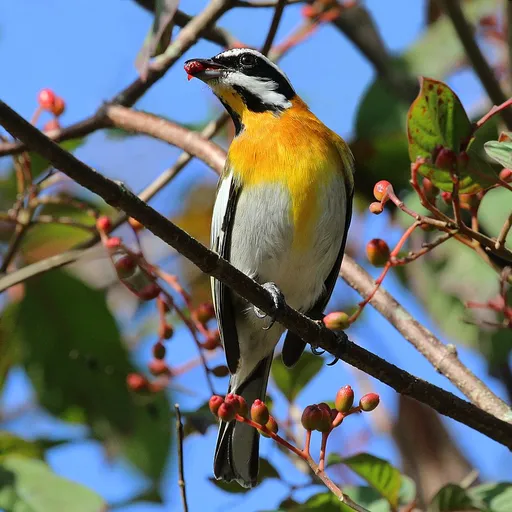
Western Spindalis
Spindalis zena
Least Concern
Overview
The western spindalis (Spindalis zena) is a songbird species that was formerly considered conspecific with other Spindalis species under the common name stripe-headed tanager. It is currently classified as a species of Least Concern on the IUCN Red List.
Identification
- Males: Brightly colored with a black and white horizontally striped head and a contrasting burnt orange throat, breast, and nape; the remainder of the belly is light grey.
- Females: Feature similar head markings but washed out to medium grey, with olive-grey upperparts, greyish-brown underparts, and a slight orange wash on the breast, rump, and shoulders.
- Size: Approximately 6.75 in (17.1 cm) in length with a wingspan of 9.5 in (24 cm) and a weight of 21 g (0.74 oz).
- Variations: Two color variations exist, with green-backed forms generally in the north and black-backed forms also generally in the north.
Habitat
The species is distributed across the western Caribbean, including Cozumel, the Cayman Islands, Cuba, the Bahamas, and the Turks and Caicos Islands, and is a rare visitor to extreme southeastern Florida. It inhabits subtropical or tropical moist lowland and montane forests, as well as heavily degraded former forests, with the S. z. zena subspecies specifically found in pine forests. The bird is nonmigratory and has a typical lifespan of 3.29 years.
Diet
The western spindalis feeds on insects, larvae, and fruit. It employs two distinct foraging techniques: gleaning, where it plucks fruit directly from the source, and hovering for fruits. Foraging typically occurs at medium to high heights off the ground.
Did you know?
The specific epithet zena derives from the Ancient Greek word for a type of finch, likely referring to the European goldfinch, despite the bird's distinct spindalis characteristics.
Sources
- Wikipedia · CC BY-SA 4.0
- Wikidata · CC0 1.0