
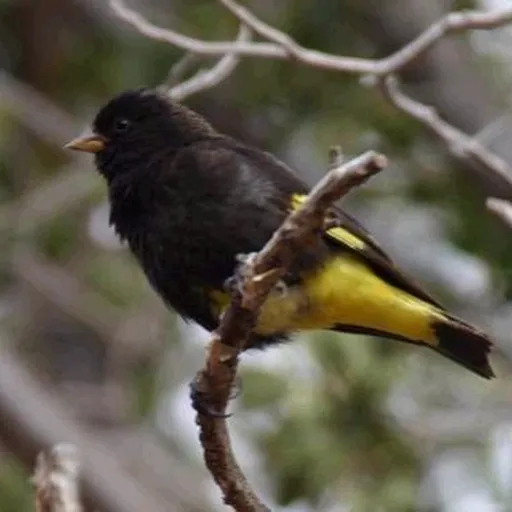
Black Siskin
Spinus atratus
Least Concern
Overview
The black siskin (Spinus atratus) is a small finch native to South America, found in Argentina, Bolivia, Chile, and Peru. It is classified as Least Concern by the IUCN, with a stable population despite occasional illegal trapping for the pet trade.
Identification
- Length of 12 to 13 cm and a weight of approximately 15 to 17 g.
- Adult males are almost entirely glossy black, with bright yellow on the tail bases, wing coverts, vent, and undertail coverts; females have browner upperparts, paler yellow markings, and variable underparts.
- Both sexes possess black irises, a dark horn upper bill, a lighter horn lower bill, and dark brown or blackish brown legs.
- The song is poorly known but likely resembles that of the yellow-rumped siskin, with flight calls described as a descending 'tew, chew, and a hew-li?'.
Habitat
Found along the Andes from north-central Peru to northern Chile and west-central Argentina, this species inhabits puna and Altiplano biomes characterised by rocky hillsides, crags, and gullies with grasses and scattered shrubs. It also occupies woodland edges, cultivated areas, and human-inhabited zones at elevations between 1,800 and 4,800 m.
Diet
The black siskin feeds primarily on seeds, foraging on the ground and in low vegetation. It forages in pairs and small flocks during the breeding season, shifting to larger mixed-species flocks afterwards.
Did you know?
Despite being assessed as a species of Least Concern, the black siskin is frequently trapped illegally for the pet trade.
Sources
- Wikipedia · CC BY-SA 4.0
- Wikidata · CC0 1.0