
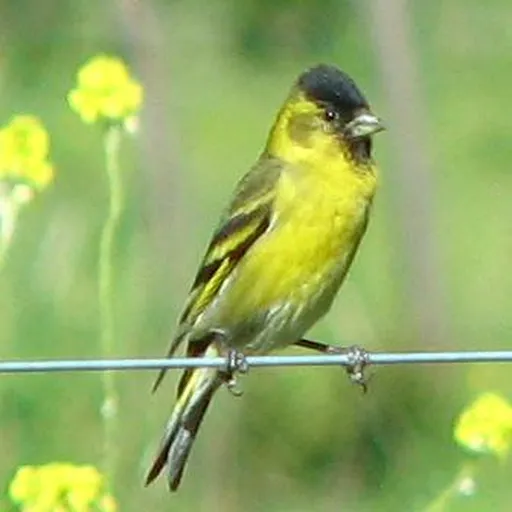
Black-chinned Siskin
Spinus barbatus
Least Concern
Overview
The black-chinned siskin (Spinus barbatus) is a small finch in the family Fringillidae, representing the most southerly member of its genus. It is classified as Least Concern by the IUCN due to its large range and stable population.
Identification
- Size and structure: 12 to 13 cm long with a dark brown or blackish bill featuring a pinkish brown base, and brown or pale pinkish brown legs.
- Male plumage: Black lores, forehead, and crown with an olive-green face marked by a bright yellowish supercilium; black chin and throat contrasting with a bright yellow breast; olive-green back with thin dark streaks and yellow to yellowish-green rump.
- Female and juvenile plumage: Females lack black on the head, displaying a greenish-yellow or olive-yellow head with a wide yellow supercilium; juveniles resemble adult females but are paler overall with no bright yellow on the face.
- Song: A loud series of musical phrases and trills, sometimes accompanied by call notes such as a rising 'tsooeet', an abrupt 'chit', or a short 'chup' in flight.
Habitat
Found in southern Chile, southern Argentina, and the Falkland Islands, this species primarily inhabits tall coniferous and broadleaf forests, as well as open country with brush, thickets, and Nothofagus shrubs. In the Falklands, it favors areas with tall tussock grass and introduced trees, while on the mainland it may also occur in suburban gardens. Elevation is typically below 1,500 m, though records exist up to 1,850 m.
Diet
The black-chinned siskin feeds primarily on seeds but has also been observed consuming insect larvae extracted from under tree bark, flowers in plum farms, and farmed flax and wheat. It forages in pairs and small flocks during the breeding season, transitioning to flocks of up to 100 individuals outside this period. Foraging occurs at all levels of its habitat, ranging from weedy patches to the forest canopy.
Did you know?
The species is a partial migrant that moves from higher elevations to plains and valleys after the breeding season, with many individuals breeding on Chile's Chiloé Island relocating to the mainland after their young have fledged.
Sources
- Wikipedia · CC BY-SA 4.0
- Wikidata · CC0 1.0