
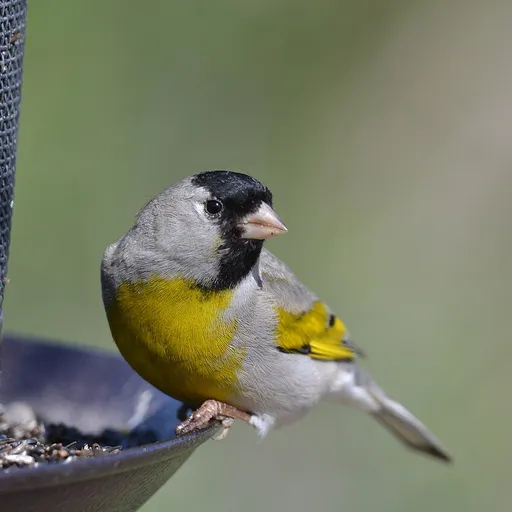
Lawrence's Goldfinch
Spinus lawrencei
Least Concern
Overview
Lawrence's goldfinch (Spinus lawrencei) is a small songbird of erratic distribution that breeds in California and Baja California, and winters in the southwestern United States and northern Mexico. It is classified as Least Concern on the IUCN Red List.
Identification
- Approximately 4.75 in (12.1 cm) long and weighing about 0.4 oz (11 g), slightly larger than the lesser goldfinch but smaller than the American goldfinch, with less yellow in the plumage.
- Adults are gray with pink to grayish flesh-coloured, stubbier bills, yellow rumps, paired yellowish wing-bars, yellow edges on flight feathers, and yellow on the breast; the tail is black with a white band.
- Males have black caps and faces with brighter yellow areas, while females are browner with duller yellow and lack the black; juveniles resemble females but are duller with faint streaks.
- Calls include a nasal 'too-err' and a high, clear flight call resembling glass wind-chimes; songs are high-pitched, continuous, and include wind-chime notes and imitations of other species.
Habitat
It breeds in dry and open woods near brushy areas and fields of tall annual weeds, usually within 0.5 mi of a small body of water, but not in deserts or dense forests. Outside the nesting season, it occupies many open habitats including deserts, suburbs, and city parks. Its range spans from Shasta County, California to northern Baja California, with irregular movements into the southwestern United States and northern Mexico.
Diet
Feeds almost entirely on seeds of shrubs and forbs, strongly favouring common fiddleneck during the nesting season. At other times, it consumes chamise achenes, mistletoe and California Buckthorn berries, and in Arizona, amaranths and inkweed. It is also attracted to niger seed at feeders.
Did you know?
This species is remarkably homogeneous with no subspecies and, according to one study, no genetic variation at the 23 loci tested.
Sources
- Wikipedia · CC BY-SA 4.0
- Wikidata · CC0 1.0