
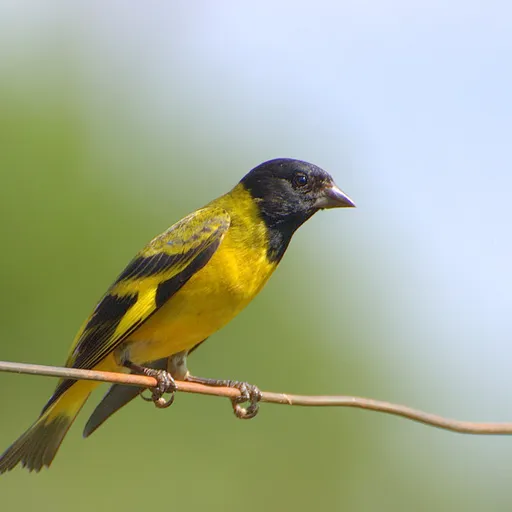
Hooded Siskin
Spinus magellanicus
Least Concern
Listen
XC251553 · Niels Krabbe · Azuay: upper Yunguilla Valley, Ecuador · CC BY-SA 4.0
Overview
The hooded siskin (Spinus magellanicus) is a small passerine bird in the family Fringillidae, recognised as the most widespread member of its genus. It is classified as Least Concern by the IUCN, although its population is believed to be decreasing, largely due to illegal trapping for the pet trade.
Identification
- Size is 10 to 12 cm long, weighing approximately 11 g, with a dark grayish-black bill and dark grey or blackish legs.
- Adult males of the nominate subspecies feature an entirely black head, throat, and upper breast, contrasted by a bright yellow collar on the nape and olive-green back.
- Females lack the black head, displaying dull olive or olive-green plumage with a gray tinge, and have paler underparts than males.
- Song consists of a varied series of rapid short twittering notes such as 'tseet-tseet' or 'tseet-weet', often sung from an open perch or in flight by multiple males in concert.
Habitat
Found in every mainland South American country except French Guiana and Suriname, this species inhabits a wide variety of landscapes including forests from lowlands to the lower montane zone, savannas, scrub, and even suburban parks. It ranges in elevation from sea level to approximately 5,000 m, favouring Polylepis forest in northern Chile.
Diet
The bird feeds primarily on a wide variety of seeds, but its diet also includes buds, leaves, flowers, nectar, fruits, and small arthropods. It has been observed ingesting sand to aid in breaking down food and often forages in flocks of up to 13 individuals during the non-breeding season.
Did you know?
The species exhibits a complicated taxonomic history, with some authors suggesting it is paraphyletic and consists of at least two distinct species. In captivity, it has been successfully crossed with the domestic canary and other finch species.
Sources
- Wikipedia · CC BY-SA 4.0
- Wikidata · CC0 1.0