
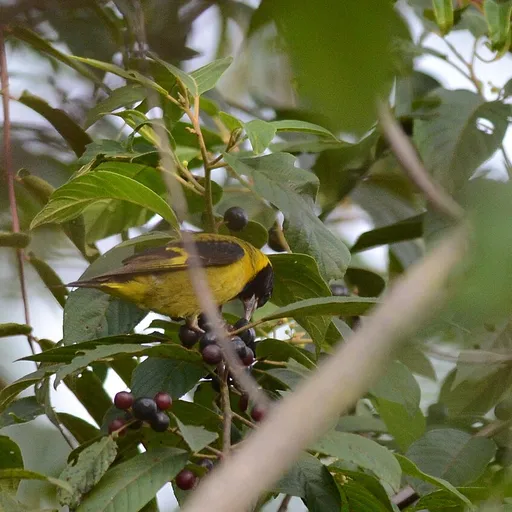
Black-headed Siskin
Spinus notatus
Least Concern
Overview
The black-headed siskin (Spinus notatus) is a small passerine bird in the family Fringillidae, native to Central America and Mexico. It is classified as Least Concern by the IUCN, though its population is believed to be decreasing, with an estimated count of at least 50,000 mature individuals.
Identification
- Males feature a black head and upper breast, yellowish olive-green upperparts, and deep yellow underparts, while females are similar but duller.
- Both sexes possess a blue-gray bill, gray legs and feet, and a brown iris.
- The song is described as a varied, rapid, jangling, twittering warble, often prolonged with odd nasal and metallic notes.
- Calls include a nasal 'teu', a drawn-out 'tseeeu', or 'djeein', a dry 'jeh-jeht', and a nasal 'ti-chie'.
Habitat
Found across a disjunct range including Mexico, Belize, El Salvador, Guatemala, Honduras, and Nicaragua, the species primarily inhabits semi-open pine-oak and oak forests as well as nearby open areas such as younger secondary forest, weedy fields, and coffee plantations. It resides at elevations generally between 600 and 3,100 metres, acting as a year-round resident.
Diet
The black-headed siskin feeds mostly on seeds. It forages in pairs and small flocks, operating through all levels of trees.
Did you know?
The species has a very large range but its estimated population of at least 50,000 mature individuals is believed to be decreasing, even though no immediate threats have been identified.
Sources
- Wikipedia · CC BY-SA 4.0
- Wikidata · CC0 1.0