
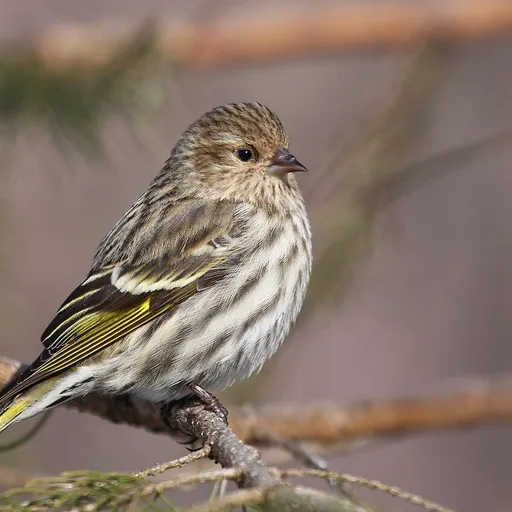
Pine Siskin
Spinus pinus
Least Concern
Listen
XC994719 · Doug Hynes · Goulds, Newfoundland and Labrador, Canada · CC BY-SA 4.0
Overview
The pine siskin (Spinus pinus) is a North American bird in the finch family, characterised by its migratory nature and extremely sporadic winter range. It is currently classified as a species of Least Concern on the IUCN Red List.
Identification
- Fairly small bird, similar in size to the American goldfinch, with a total length of 11–14 cm.
- Brown upperparts and pale underparts featuring heavy streaking throughout the body.
- Conical bill that is more elongated and slender than those of co-occurring finches.
- Variably displays yellow patches on the wings and tails, or white streaks on the wings, alongside a short, forked tail.
Habitat
Breeding occurs across almost the entirety of Canada, Alaska, and variably across the western mountains and northern United States, primarily in open conifer forests. They also utilise ornamental conifers or deciduous trees in partially developed parks, cemeteries, and suburban woodlands for nesting. While they favour open forest canopies, they forage in diverse environments including deciduous forests, meadows, grasslands, and backyard gardens.
Diet
Mainly consume small seeds such as thistle, red alder, birch, and spruce, as well as plant parts like young buds and soft stems, and some insects including aphids. They forage in trees, shrubs, and weeds, often joining mixed flocks with American goldfinches and redpolls in winter. In their crop, they can store up to 10% of their body weight in seeds overnight to sustain them on cold days.
Did you know?
Pine siskins possess metabolic rates typically 40% higher than a normal songbird of their size, allowing them to accelerate this rate up to five times normal for several hours when temperatures drop to −70 °C. They also put on half again as much winter fat as their common redpoll and American goldfinch relatives.
Sources
- Wikipedia · CC BY-SA 4.0
- Wikidata · CC0 1.0