
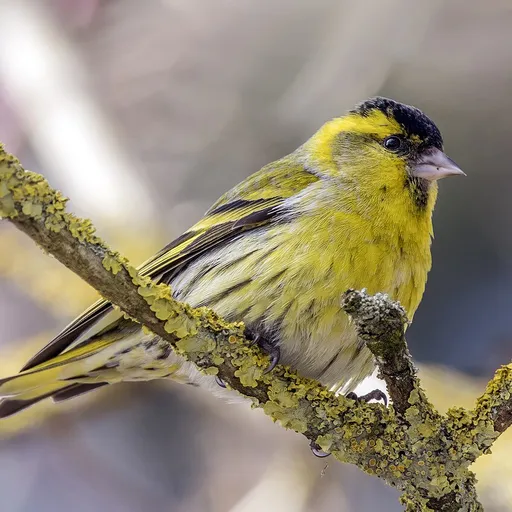
Eurasian Siskin
Spinus spinus
Least Concern
Listen
XC731703 · Sonothèque ADVL · Dragey-Ronthon, Manche, Normandie, France · CC0 1.0
Overview
The Eurasian siskin, Spinus spinus, is a small passerine bird in the finch family Fringillidae, also known by the names European siskin, common siskin, or just siskin. It is a brightly coloured, active, and sociable species that is very common throughout Europe and Eurosiberia.
Identification
- Small, short-tailed bird measuring 11–12.5 cm in length with a wingspan of 20–23 cm.
- Upperparts are greyish green, and underparts are grey-streaked white; wings are black with a striking yellow wing bar and a black tail with yellow sides.
- Males display a predominantly yellow face and breast with a neat black cap, while females and young birds have a greyish-green head without a cap.
- Song is a pleasant mix of tweets and trills, with two distinct calls described as descending "tilu" and ascending "tluih".
Habitat
It is found across the greater part of Eurosiberia and the north of Africa, inhabiting forested areas with a predilection for humid regions. Coniferous woodlands, especially spruce, are favoured for breeding, while mixed woodland and areas with seed-bearing trees are used in winter.
Diet
Primarily a granivore, it feeds on seeds of coniferous and broadleaf trees, with a strong preference for alder, spruce, and birch. It also consumes seeds from cultivated plants like thistles and dandelions, and insects during the breeding season to feed its young. It is an acrobatic feeder that often hangs upside down to access seeds in spruce cones and alder fruit.
Did you know?
Siskins exhibit an unusual migration pattern, moving southwards in large numbers every few years in winter, a behaviour possibly linked to climatic factors and food availability. They are one of the few species described as exhibiting "allofeeding" behaviour, where subordinates regurgitate food for dominant flock members.
Sources
- Wikipedia · CC BY-SA 4.0
- Wikidata · CC0 1.0