
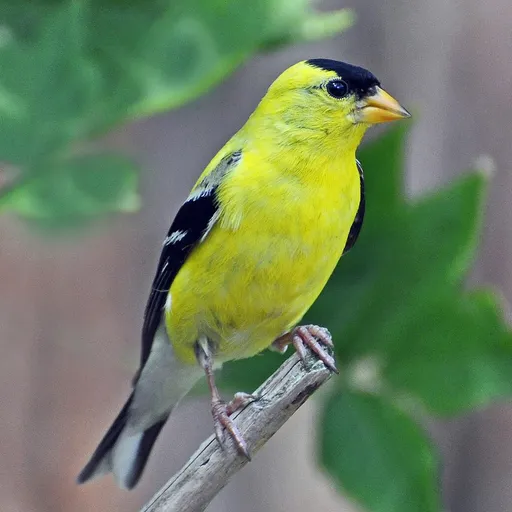
American Goldfinch
Spinus tristis
Least Concern
Listen
XC483030 · Kevin Hood · Vancouver Island (near Oliver Woods Centre Pond), Nanaimo, British Columbia, Canada · CC BY-SA 4.0
Overview
The American goldfinch (Spinus tristis) is a small, migratory North American bird in the finch family, classified as Least Concern on the IUCN Red List. It is characterised by its vibrant seasonal plumage changes and a preference for open habitats where weeds thrive.
Identification
- Small finch measuring 11–14 cm in length, with a small, conical bill that is pink for most of the year but turns bright orange in spring.
- Summer male plumage is brilliant lemon yellow with a jet black cap and white rump, while the female is mostly brown with a yellow bib; winter plumage for both sexes is dull olive-brown and buff.
- Song consists of musical warbles and twitters often ending with a long note, accompanied by calls in flight described as 'tsee-tsi-tsi-tsit' or 'per-chic-o-ree'.
- Flies in a distinctive undulating, wave-shaped path, flapping to lift and then gliding in an arc.
Habitat
Prefers open country where weeds thrive, such as fields, meadows, flood plains, roadsides, orchards, and gardens, as well as open deciduous and riparian woodlands. Its breeding range extends coast to coast across North America from Saskatchewan in the north to North Carolina and northern California in the south, while its winter range covers southern Canada, the United States, and parts of Mexico.
Diet
Primarily a granivore, feeding on seeds from weeds, grasses, and trees such as thistle, teasel, dandelion, and sunflower, though it also consumes tree buds, maple sap, berries, and occasionally insects. It is highly adapted for eating seedheads, using agile feet to grip stems while its conical beak extracts seeds, and frequently hangs from seedheads or pulls catkins with its toes to reach food.
Did you know?
It is the only finch in its subfamily to undergo a complete molt, shedding all its feathers during winter and all but its wing and tail feathers in spring. Its breeding season begins in late July, which is the latest of any finch and later than any other native North American bird besides occasionally the sedge wren.
Sources
- Wikipedia · CC BY-SA 4.0
- Wikidata · CC0 1.0