
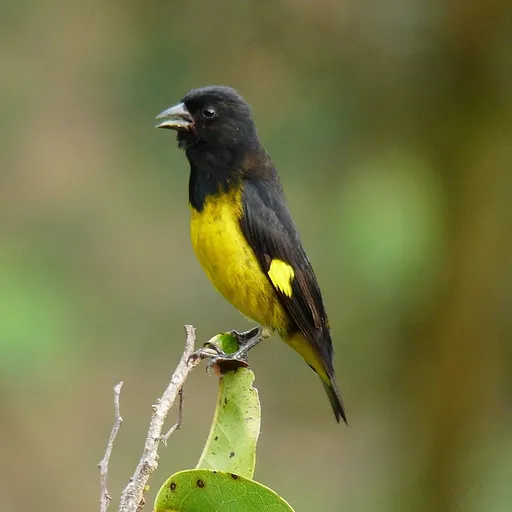
Yellow-bellied Siskin
Spinus xanthogastrus
Least Concern
Overview
The yellow-bellied siskin (Spinus xanthogastrus) is a small passerine bird in the family Fringillidae, native to the forests of Central and South America. It occupies a highly disjunct range, extending from Costa Rica in the north to Bolivia in the south.
Identification
- Size: Small passerine, measuring 10 to 11.5 cm in length.
- Plumage: Adult males feature glossy black heads, chins, breasts, and upperparts with bright yellow bellies; females are mostly dull olive-green with paler supercilia and olive-yellow underparts.
- Bill and Legs: Possesses a dark brown or blackish bill and dark brown legs and feet.
- Song: Described as a fast, bubbly series of twitters, buzzy notes, and musical sputterings, often mixed with high, thin notes and low nasal tones.
Habitat
Found in the edges of humid evergreen and semi-deciduous forests, clearings with scattered trees, high-elevation pastures, and coffee plantations in upper tropical and subtropical zones. Elevational ranges vary by region, typically between 800 m and 3,700 m, though it is most numerous between 1,400 m and 2,000 m. The species is non-migratory but exhibits some nomadic movement within its ranges.
Diet
Feeds primarily on seeds, foraging singly, in pairs, or in small flocks during the breeding season, and in flocks of up to 30 individuals outside it. Foraging activity is concentrated in the forest mid-story and canopy, though it occasionally visits lower areas and vegetation near the ground.
Did you know?
Males are heavily trapped in some areas for the cagebird trade, where they are highly sought after for cross-breeding with domestic canaries.
Sources
- Wikipedia · CC BY-SA 4.0
- Wikidata · CC0 1.0