
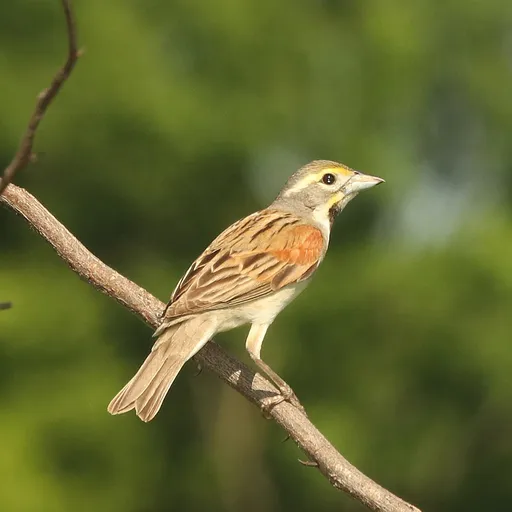
Dickcissel
Spiza americana
Least Concern
Listen
XC903275 · steve · Hobucken, Pamlico County, North Carolina, United States · CC BY-SA 4.0
Overview
The dickcissel, Spiza americana, is a small, seed-eating migratory bird that breeds in the prairie grasslands of the Midwestern United States. As the sole member of the genus Spiza, it is distinguished within its family by its robust, cone-shaped bill and the absence of blue structural colours in its plumage.
Identification
- Length of 5.5–6.3 in (140–160 mm) with a large, pale, cone-shaped bill.
- Adult males display a black throat, yellow breast, and grey cheeks and crown, resembling an eastern meadowlark in breeding plumage.
- Females and juveniles are brownish with streaked flanks and greyish cheeks, appearing similar to house sparrows.
- Distinctive flight call is a low, 'electric' buzzing fpppt, while the song from an open perch is a sharp dick dick followed by a buzzed cissel.
Habitat
Breeding habitat consists of fields in midwestern North America, where the species historically spread eastward from tallgrass prairies before its range decreased significantly after 1850. During the winter, the species migrates in large flocks to southern Mexico, Central America, and northern South America.
Diet
Dickcissels forage on the ground or in fields, mainly consuming insects and seeds. Outside of the nesting season, they feed in flocks and are considered a pest by some farmers due to their consumption of large quantities of cultivated grains.
Did you know?
Dickcissels are among the few songbirds that are truly polygynous, with males potentially having up to six mates, though partners only stay together to raise a single brood before the bonds are broken when the birds migrate for winter.
Sources
- Wikipedia · CC BY-SA 4.0
- Wikidata · CC0 1.0