
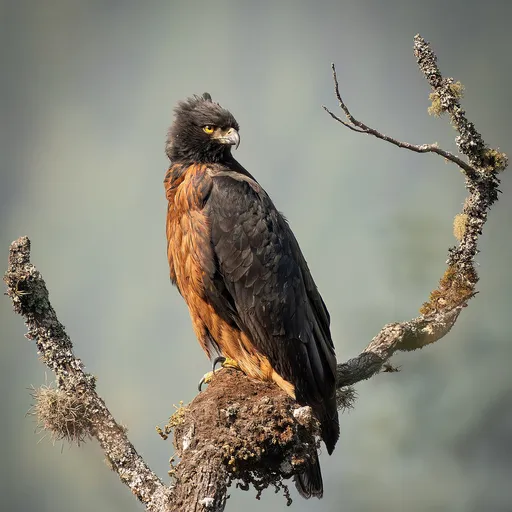
Black-and-chestnut Eagle
Spizaetus isidori
Endangered
Listen
XC688348 · Andres Felipe Espinosa · Chaparral, Tolima, Colombia · CC BY-SA 4.0
Overview
The black-and-chestnut eagle (Spizaetus isidori), also known as Isidor's eagle, is a large forest raptor in the family Accipitridae. It is listed as Endangered on the IUCN Red List due to habitat destruction and persecution, with an estimated 1,400–4,200 mature individuals remaining in the wild.
Identification
- Adults: Glossy black on the head and back; rich, streaky chestnut on the underside, wing secondaries, and legs; orange-yellow eyes and yellow bare parts with a proportionately small grey bill.
- Juveniles: Whitish head and body with a buffy wash underneath; scaly grey-brown back; blue-grey eyes that later turn yellow then orangish.
- Size: Very large raptor, 60–80 cm (24–31 in) in length with a wingspan of 147–180 cm (4 ft 10 in to 5 ft 11 in); females are 4–14% larger and longer-tailed than males.
- Tail: Greyish with a thick black subterminal band in adults; juveniles have two strong black bands.
- Tail & Crest behaviour: Unusually, the crest is held upright in calm conditions and in flight, and more likely to lie flat when stressed.
Habitat
The black-and-chestnut eagle is a typical forest raptor found in humid montane forests of the Andes, typically at elevations between 1,800 and 2,500 m (5,900–8,200 ft). Its range extends from northern Argentina through Bolivia, Peru, Ecuador, Colombia, and Venezuela, with isolated populations in the Venezuelan Coastal Range, Serranía del Perijá, and Sierra Nevada de Santa Marta.
Diet
Primarily small- to medium-sized arboreal mammals such as red-tailed squirrels, opossums, and stump-tailed porcupines, as well as birds including domestic chickens and guans. It also occasionally takes carnivorans like kinkajous and coatis, and monkeys such as grey-bellied night monkeys and woolly monkeys. Foraging is primarily in the canopy, often soaring and rarely seen perched, with powerful talons and legs specialised for catching large prey.
Did you know?
Unlike other crested raptors, the black-and-chestnut eagle is reported to hold its crest upright during calm periods and in flight, and more likely to hold it flat when stressed.
Sources
- Wikipedia · CC BY-SA 4.0
- Wikidata · CC0 1.0