
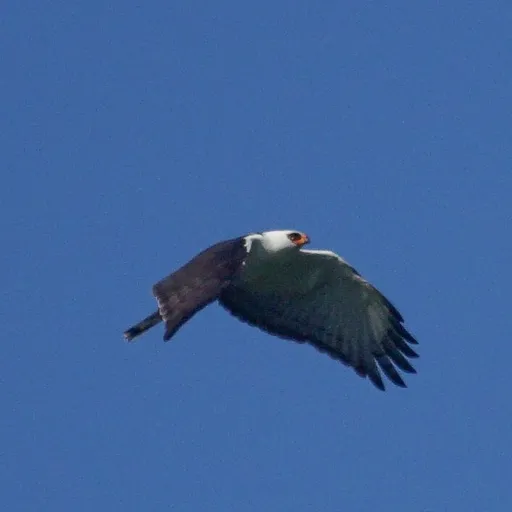
Black-and-white Hawk-Eagle
Spizaetus melanoleucus
Least Concern
Overview
The black-and-white hawk-eagle (Spizaetus melanoleucus) is a bird of prey species in the eagle and hawk family found throughout tropical America, from southern Mexico to northern Argentina. It is classified as Least Concern on the IUCN Red List, although it remains a rare and local species across its range.
Identification
- 20–24 in (51–61 cm) long, weighing about 30 oz (850 g), with white head, neck and body.
- Black wings with a noticeable white leading edge, and a brownish tail barred black-dark grey with a white tip.
- Orange irises in adults, greyish in juveniles, and a black bill with a yellow cere.
- Black spot formed by a small crest on top of the head, with black around the eyes particularly towards the bill.
Habitat
Found in lowland forests of any type, though it avoids very dense, humid, and savanna-like semiarid habitats. It requires large stands of closed-canopy forest to thrive and prefers diverse habitats of mixed forest and shrubland. Its range extends from southern Mexico through Central America, excluding most of El Salvador and the Pacific coast of Nicaragua, to northern Argentina, with a presence on the Pacific side of the Andes in Ecuador and a population in the Loreto Region of northeast Peru.
Diet
This carnivore feeds on mammals, toads, squamates, and a wide variety of birds, with a preference for tree-living species such as oropendolas, aracaris, tanagers and cotingas. It soars high to spot prey and then dives down, usually into the forest canopy, but has been observed catching prey in mid-air. It hunts along ridges and forest edges where it can access the canopy from an oblique direction and where ground-living prey is more accessible.
Did you know?
Despite being described as a rare and local species, each bird requires a hunting territory of about 3,500 acres (1,400 hectares). It has been known to attack small monkeys, including the highly threatened Rylands' bald-faced saki, and has even been recorded preying on the highly threatened Brazilian merganser.
Sources
- Wikipedia · CC BY-SA 4.0
- Wikidata · CC0 1.0