
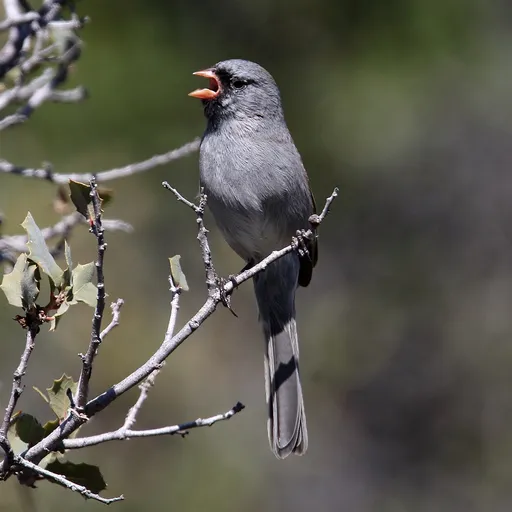
Black-chinned Sparrow
Spizella atrogularis
Least Concern
Listen
XC705800 · Diana Doyle · Spitler Peak Trail, San Jacinto Mtns, Riverside County, California, United States · CC BY-SA 4.0
Overview
The black-chinned sparrow (Spizella atrogularis) is a small passerine bird in the family Passerellidae, native to the southwestern United States and northern Mexico. It is characterised by its slender build, long tail, and preference for arid environments, though it has been classified as a species of least concern due to its large global population and range.
Identification
- A slim, round-headed bird with a long, notched tail that is proportionately longer than that of other Spizella species.
- Primarily grey plumage with a reddish-brown back streaked in black, brown wings and tail, and a pink bill.
- Breeding males display extensive black on the chin, throat, and front of the face, while females and non-breeding birds lack this marking.
- Song consists of a series of clear, high-pitched whistles that accelerate into a rapid, 'mechanical' trill, often described as sounding like a dropped ping-pong ball.
Habitat
This species inhabits arid and semi-arid areas such as chaparral, sagebrush, pine-juniper woodlands, and rocky shrublands across the southwestern United States and Mexico north of the Isthmus of Tehuantepec. It typically occupies elevations from near sea level up to 2,400 m in the United States and 2,500 m in Mexico, often favouring remote, rugged terrain while avoiding coastal regions and edge habitats.
Diet
An omnivore that forages slowly on or near the ground, primarily consuming seeds during the winter and insects during the summer. It occasionally captures insects in flight or feeds on seeds while perched in a bush, and it generally obtains all its moisture from food in summer, though it may travel considerable distances to reach water sources in winter.
Did you know?
Despite being an inconspicuous species that often remains in deep cover, breeding males defy this typical behaviour by selecting conspicuous, exposed perches to sing and defend their territory.
Sources
- Wikipedia · CC BY-SA 4.0
- Wikidata · CC0 1.0