
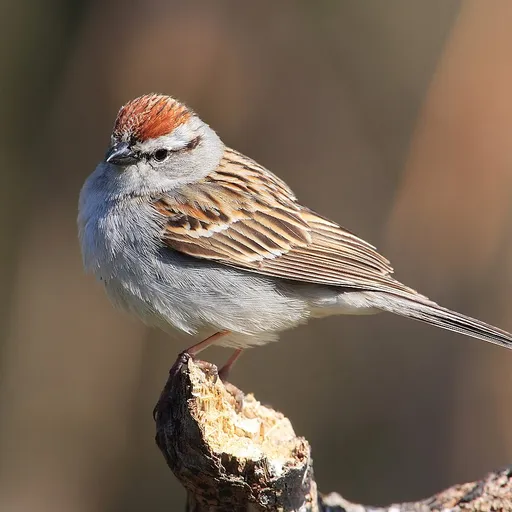
Chipping Sparrow
Spizella passerina
Least Concern
Listen
XC311824 · Tom Austin · Donnelley WMA, Colleton County, South Carolina, United States · CC BY-SA 4.0
Overview
The chipping sparrow (Spizella passerina) is a species of New World sparrow and passerine bird in the family Passerellidae. It is widespread, fairly tame, and common across most of its North American range. As a partial migrant, northerly populations fly southwards in the fall to overwinter in Mexico and the southern United States.
Identification
- Adults are grey below and orangish-rust above, with a distinctive reddish cap, nearly white supercilium, and black trans-ocular line in breeding plumage.
- Non-breeding adults and juveniles are less prominently marked, featuring a brownish cap, a dusky eyebrow, and a dark eye-line.
- Adults measure 4.7–5.9 in (12–15 cm) in length, with a wingspan of 8.3 in (21 cm) and a weight of 0.4–0.6 oz (11–17 g).
- The song is described as a trill, and the bird has a piercing flight call audible during nocturnal migration.
Habitat
In the west of their range, chipping sparrows breed mainly in coniferous forests, while in the east they choose woodland, farmland, parks, and gardens. They inhabit grassy, open woodland clearings and shrubby grass fields, with nests typically built below 6 metres (20 ft) in height in trees or bushes. This species has a long association with human habitations, inhabiting cities in large numbers where house sparrows are not present.
Diet
Chipping sparrows feed on seeds year-round, though insects form most of the diet in the breeding season, with spiders sometimes taken as well. They forage on the ground in covered areas, often near the edges of fields, and also clamber on plants and trees to feed on buds and small arthropods.
Did you know?
Before the introduction of house sparrows to North America, chipping sparrows filled much the same niche, inhabiting cities in large numbers. They continue to be associated with human habitations and remain relatively unafraid of people in areas where house sparrows are absent.
Sources
- Wikipedia · CC BY-SA 4.0
- Wikidata · CC0 1.0