
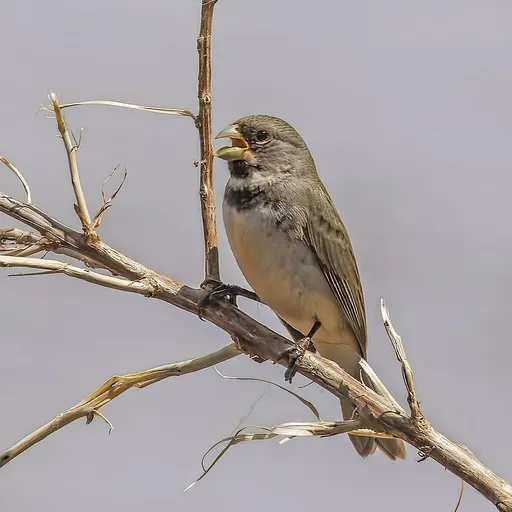
Double-collared Seedeater
Sporophila caerulescens
Least Concern
Overview
The double-collared seedeater (Sporophila caerulescens) is a small bird belonging to the family Thraupidae. It is distributed across much of South America, including Argentina, Bolivia, Brazil, Colombia, Paraguay, Peru, and Uruguay.
Identification
- Approximately 11 cm long with a short, thick bill featuring a rounded culmen.
- Males exhibit sexually dimorphic plumage with a lead-grey head, black forehead, and distinct white crescents under the eyes and below a black 'moustache' on the throat.
- Females are predominantly warm buffy brown across the head, back, and underparts, contrasting with the males' darker markings.
- Song is described as loud and varied, consisting of jumbled notes such as 'jew, jitit-jew-jew' or 'jewle, jewle', with significant regional variation.
Habitat
This species inhabits somewhat open landscapes, including forest edges, shrubby openings, young secondary forest, cerrado, agricultural lands, and towns, though it is rarely found in large grasslands. Its range extends from sea level up to 1,200 m in Brazil and 1,000 m in Peru, with recorded vagrancies in Chile and the Falkland Islands.
Diet
The double-collared seedeater feeds primarily on grass seeds, including those of introduced species. It forages both while clinging to grass stems and on the ground, typically singly or in pairs during the breeding season but forming small flocks otherwise.
Did you know?
The species is a popular cage bird, meaning that the impact of trapping on its population numbers remains a significant consideration despite its current status of Least Concern.
Sources
- Wikipedia · CC BY-SA 4.0
- Wikidata · CC0 1.0