
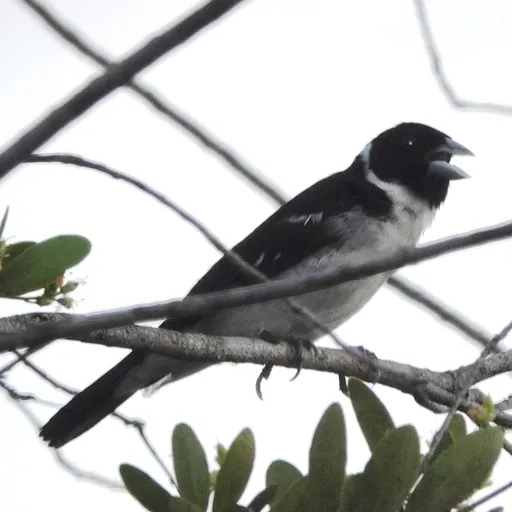
White-naped Seedeater
Sporophila fringilloides
Least Concern
Overview
The white-naped seedeater (Sporophila fringilloides) is a species of bird in the family Thraupidae. It is a small, sexually dimorphic passerine found in the white-sand forests of northern and southern South America. The IUCN has assessed the species as being of Least Concern, with a population that is believed to be stable.
Identification
- Males have a black head with a distinct white collar, black upperparts with a white rump, and a bold white wing bar, contrasted with mostly white underparts featuring a small black breast wedge.
- Females are dull brown above and brownish below, with a whitish belly, resembling juveniles.
- The bird is 13 to 13.5 cm long, slim, with a longish tail and a large, sharp, triangular bill; males have an ivory to light blue bill, while females have a gray bill.
- The male's song is fast and musical, consisting of sets of paired notes or triplets (e.g., ne-ne-ne, te-te-te), whereas the call is a sharp tzink.
Habitat
The species primarily inhabits forest on nutrient-poor white sand, though it also occurs along the edges of forests on richer soils and in grassy savanna. It favours landscapes with abundant large-leafed herbaceous plants and terrestrial arums. Its range extends from southeastern Colombia east into southern Venezuela and slightly into northwestern Brazil, with scattered records further east in Brazil and a single record in southern Guyana.
Diet
The white-naped seedeater feeds primarily on seeds, supplemented by insects and mistletoe berries. It typically forages singly or in pairs, occasionally reaching up to 4 m above the ground, and rarely joins mixed-species feeding flocks.
Did you know?
Despite being described in 1870 as a finch, the species was formally moved to the tanager family Thraupidae in 2012 following decades of taxonomic studies.
Sources
- Wikipedia · CC BY-SA 4.0
- Wikidata · CC0 1.0