
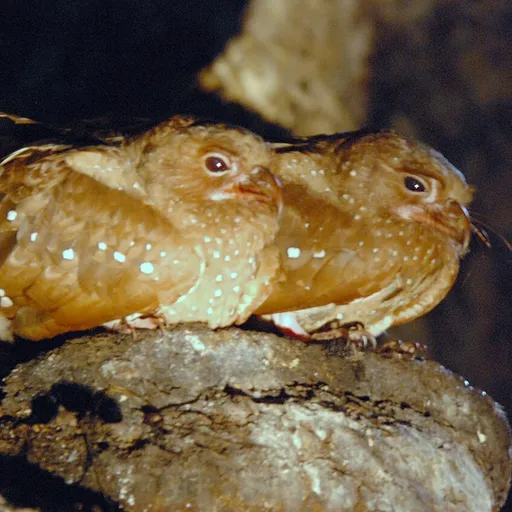
Oilbird
Steatornis caripensis
Least Concern
Overview
The oilbird, locally known as the guácharo, is the only living species in the family Steatornithidae and the only nocturnal flying fruit-eating bird in the world. It is a large, slim bird found in the northern areas of South America and the Caribbean island of Trinidad.
Identification
- A large, slim bird measuring 40–49 cm in length with a wing span of 95 cm.
- Plumage is mainly reddish-brown with white spots on the nape and wings; lower parts are cinnamon-buff with white diamond-shaped spots edged in black.
- Possesses a flattened, powerfully hooked beak surrounded by deep chestnut rictal bristles.
- Produces a high-pitched clicking sound of around 2 kHz for echolocation, as well as harsh screams, particularly when entering caves or preparing to emerge at dusk.
Habitat
Ranges from Guyana, Trinidad and Tobago to Venezuela, Colombia, Ecuador, Peru, Bolivia and Brazil, at altitudes from sea level to 3,400 m. Requires caves for breeding and frequent roosting, alongside forest containing fruiting trees, though non-breeding individuals also roost in trees. It is a seasonal migrant that moves from breeding caves in search of fruit.
Diet
Specialist frugivore that feeds on the fruits of the oil palm and tropical laurels. Forages at night using specially adapted eyesight and echolocation.
Did you know?
Oilbirds navigate by echolocation in the same way as bats, producing audible clicks, and are among the few birds known to do so alongside some species of swift.
Sources
- Wikipedia · CC BY-SA 4.0
- Wikidata · CC0 1.0