
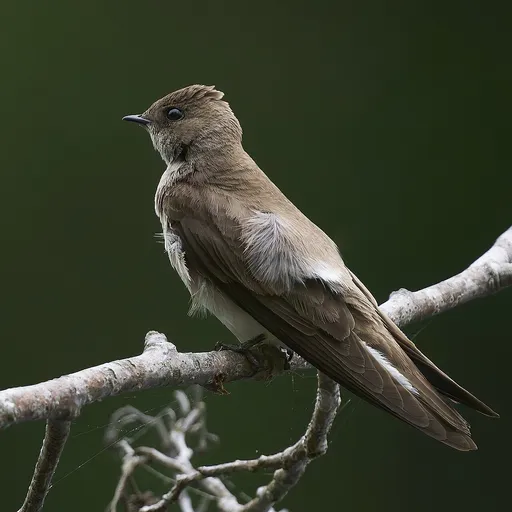
Northern Rough-winged Swallow
Stelgidopteryx serripennis
Least Concern
Overview
The northern rough-winged swallow (Stelgidopteryx serripennis) is a small, migratory bird belonging to the swallow family. It is closely related to and very similar in appearance to the southern rough-winged swallow. The species is currently classified as Least Concern by the IUCN.
Identification
- Adults measure 13–15 cm in length with a wingspan of 27–30 cm, featuring brown upperparts, white underparts, and a forked tail.
- The throat displays a white base with a brownish-grey wash, distinguishing it from similar species like the bank swallow.
- Juveniles can be identified by reddish-brown wing-bars, whereas males possess hooked barbs on the outer web of their outer primary wings.
- The call is a short, harsh zeep or rough, low bzzt, which is often doubled.
Habitat
Native to regions ranging from southern Alaska and Canada to Panama, this species occupies a wide range across North and Central America. The nominate subspecies breeds in the north and winters in southern Florida, Mexico, and Panama, while southern populations remain resident. It has been recorded at elevations as high as 2,500 m in Costa Rica.
Diet
This insectivore feeds almost exclusively on flying insects, typically foraging over water and occasionally over land. Its flight path during foraging is low and direct, characterised by slow, deep wingbeats interspersed with periods of gliding. A single report notes some feeding on cracked corn, and the bird drinks by skimming the water surface with its wing.
Did you know?
The bird's common name refers to the serrated edges of its wing feathers, a feature that is only apparent when the bird is physically held. Additionally, these swallows have a unique method of drinking, skimming the surface of water with their wings to collect the moisture before drinking it.
Sources
- Wikipedia · CC BY-SA 4.0
- Wikidata · CC0 1.0