
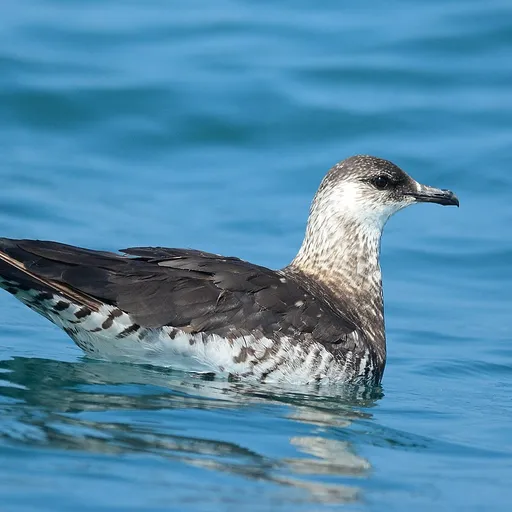
Parasitic Jaeger
Stercorarius parasiticus
Least Concern
Listen
XC609518 · Doug Hynes · near Churchill Northern Studies Centre, Manitoba, Canada · CC BY-SA 4.0
Overview
The parasitic jaeger, also known as the arctic skua, is a migratory seabird in the family Stercorariidae. It breeds across the northern hemisphere, including Scandinavia, Iceland, Greenland, northern Canada, and Siberia, before wintering in the tropics and southern oceans. The species is globally listed as Least Concern by the IUCN, though it has been uplisted to Endangered in Iceland due to recent population declines.
Identification
- Measures 41–48 cm in length with a 107–125 cm wingspan, featuring a pointed central tail projection in breeding adults that accounts for approximately 7 cm of their length.
- Exhibits three colour morphs: light-morph adults have a brown back, white underparts, and a yellowish-white head with a black cap; dark-morph adults are dark brown; and intermediate birds are dark with paler underparts.
- All morphs display a white 'flash' on the dark primary wing feathers, and the flight is described as more falcon-like than other jaegers.
- Produces a typical nasal mewing sound repeated a few times during display, with a shorter alarm call.
Habitat
This species breeds on dry tundra, higher fells, and islands in the far north of Eurasia and North America. It is a migratory species that winters at sea in the tropics and southern oceans, with some overland migration routes passing through areas such as the Canning River Valley in Alaska and the Persian Gulf. Significant breeding populations are found in northern Scotland, Shetland, Orkney, the Outer Hebrides, and parts of northern Canada.
Diet
During the breeding season, the bird feeds on rodents, insects, eggs, chicks, and small birds. However, the majority of its diet, particularly during migration and winter, consists of food acquired through kleptoparasitism, where it robs other birds, primarily gulls and terns, of their catches.
Did you know?
The genus name Stercorarius is Latin for 'of dung', as the food disgorged by other birds when pursued by skuas was once mistaken for excrement. The English name 'skua' derives from the Faroese word skúgvur for the great skua, associated with the island of Skúvoy.
Sources
- Wikipedia · CC BY-SA 4.0
- Wikidata · CC0 1.0