
River Tern
Sterna aurantia
Vulnerable
Overview
The river tern, also known as the Indian river tern, is the largest species currently included in the genus Sterna of typical terns. It is classified as a vulnerable species by the IUCN Red List. Unlike most of its relatives, it is almost exclusively found on freshwater systems and rarely ventures to tidal creeks.
Identification
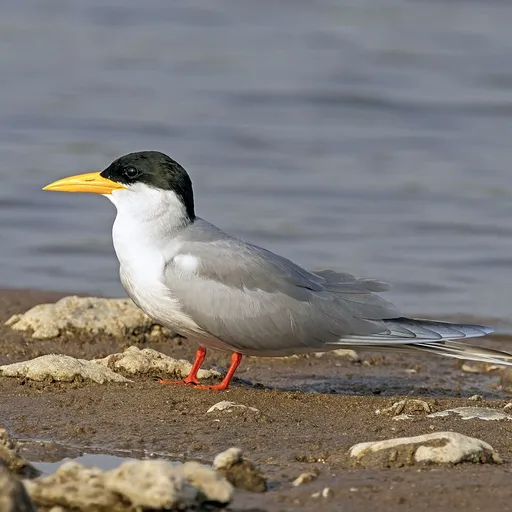
- Medium-large tern measuring 38–46 cm in length with a wingspan of 80–85 cm, making it distinctly larger than other Sterna species and comparable in size to a Sandwich tern.
- Features dark grey upperparts, white or very pale grey underparts, and a forked tail with long flexible streamers in summer, though the two longest outer tail feathers are lost in winter.
- Possesses a stout bill that is bright yellow in summer and duller with a dusky tip in winter, paired with bright red legs.
- Displays a black cap in breeding plumage that extends well below the eye, changing to a greyish-white, flecked cap with a dark eye mask in winter.
Habitat
A resident breeder along inland rivers from Pakistan east through the Indian subcontinent to Myanmar, Thailand, and Cambodia, where it is uncommon. It is typically a lowland riverine freshwater species occurring mainly from 0–600 m altitude, though it has been exceptionally recorded at 2,706 m in the Upper Indus valley. It also extensively uses freshwater reservoirs, and its range excludes Sri Lanka despite its proximity in southern India, highlighting its reluctance to cross the sea.
Diet
Feeds by plunge-diving for fish, crustaceans, tadpoles, and aquatic insects in rivers, lakes, and tanks. This foraging behaviour is consistent with other Sterna terns but is conducted within freshwater habitats.
Did you know?
The species shows a strong reluctance to use or cross the sea, evidenced by the absence of any records from Sri Lanka despite it being widespread in Kerala and Tamil Nadu in southernmost India. It has also been recorded as a vagrant in Afghanistan and Iran.
Sources
- Wikipedia · CC BY-SA 4.0
- Wikidata · CC0 1.0