
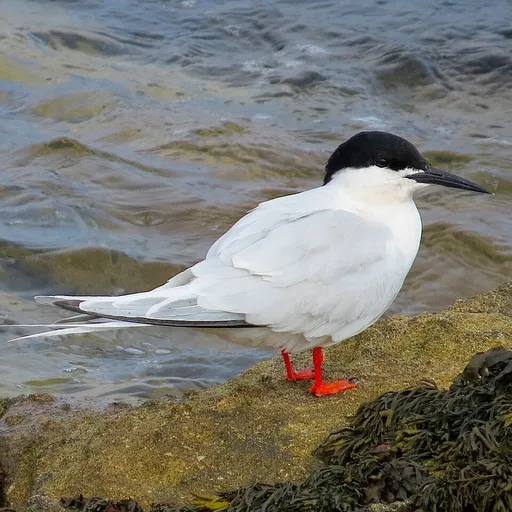
Roseate Tern
Sterna dougallii
Least Concern
Listen
XC1042803 · Sonothèque ADVL · Saint-Jacut-de-la-Mer, Côtes-d'Armor, Brittany, France · CC0 1.0
Overview
The roseate tern (Sterna dougallii) is a species of tern in the family Laridae, characterised by its pinkish tinge in breeding plumage. It is currently classified as Least Concern on the IUCN Red List, although specific populations such as those in the northeastern United States and Canada are listed as Endangered or Threatened. Conservation efforts, particularly the provision of nest boxes, have successfully reversed long-term declines in certain colonies.
Identification
- Size: Small to medium tern, measuring 33–36 cm in length with a 67–76 cm wingspan.
- Plumage: Underparts are white in winter but take on a pinkish 'roseate' tinge in summer; upper wings are pale grey and outermost primaries darken in summer; adults have long, flexible tail streamers and orange-red legs.
- Bill: Thin and sharp, black with a red base that develops through the breeding season and may be fully red in tropical subspecies; bill becomes entirely black in winter.
- Vocalisation: Emits a very characteristic 'chuwit' call, similar to that of the spotted redshank and distinct from other terns.
Habitat
This species breeds in colonies on coasts and islands, sometimes alongside other seabirds. The nominate subspecies breeds on the Atlantic coasts of Europe and North America, while tropical forms breed across the Indian Ocean and in Australia. Nesting sites often include ground scrapes in hollows or under dense vegetation.
Diet
The roseate tern feeds by plunge-diving for fish, almost invariably from the sea, and is more marine than allied terns. Unusually for a tern, it exhibits kleptoparasitic behaviour, stealing fish from other seabirds such as puffins, which aids in food collection during bad weather when fish dive deeper.
Did you know?
The bird was hunted for its plumes in the late 19th century, which were used to decorate hats. It is also notable for having some of the largest known female-female pairs among seabirds, with around 12% of nests at one site recorded as attended by female-female pairs between 1970 and 1995.
Sources
- Wikipedia · CC BY-SA 4.0
- Wikidata · CC0 1.0