
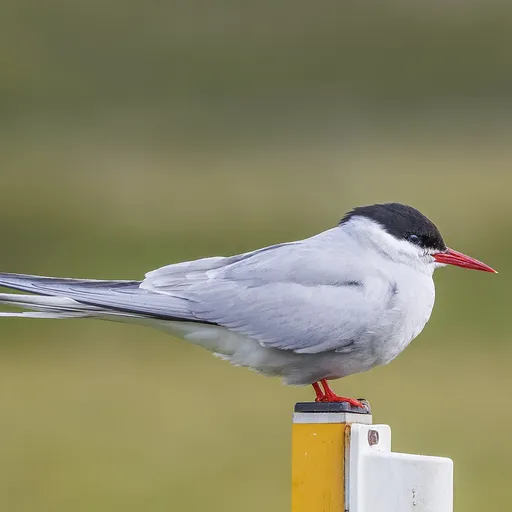
Arctic Tern
Sterna paradisaea
Least Concern
Listen
XC1176897 · Sonothèque ADVL · Genêts, Manche, Normandy, France · CC0 1.0
Overview
The Arctic tern, Sterna paradisaea, is a medium-sized seabird in the family Laridae, celebrated for holding the record for the longest migration of any animal. It breeds across the Arctic and subarctic regions of the Northern Hemisphere and migrates to the Antarctic to experience two summers in a single year. The species is currently classified as Least Concern by the IUCN, with an estimated global population exceeding two million individuals.
Identification
- Medium-sized tern measuring 33–36 cm in length with a 76–85 cm wingspan and a weight of roughly 100 g.
- In the breeding season, features a grey mantle and upper wings with white underparts, a black crown and nape, white cheeks, and blood-red beak and feet.
- In winter, the forehead becomes partly white and the bill and legs turn black, while juveniles display scaly wings and dark feather tips on the mantle.
- Call is described as nasal and rasping, easily distinguishable from similar species and noted in some accounts to resemble the sound of the band name Backstreet Boys.
Habitat
This species possesses a circumpolar breeding distribution that spans the Arctic and subarctic regions of Europe, Asia, and North America. During the southern summer, it migrates to the waters surrounding the northern edge of the Antarctic ice, though it typically remains sufficiently offshore that it is rarely seen from land outside the breeding season.
Diet
The Arctic tern is carnivorous, consuming a diet composed primarily of small fish, such as herring, cod, and capelin, along with marine invertebrates like amphipods, crabs, and krill. It forages by dipping down to the surface of the water to catch prey and sometimes engages in kleptoparasitism by swooping at other birds to force them to release their catches.
Did you know?
An individual Arctic tern tracked on the Farne Islands in Northumberland covered a staggering 96,000 km in ten months, a distance that is more than twice the circumference of the Earth. Over its long lifespan, an average Arctic tern may travel the equivalent of a round trip to the Moon more than three times.
Sources
- Wikipedia · CC BY-SA 4.0
- Wikidata · CC0 1.0