
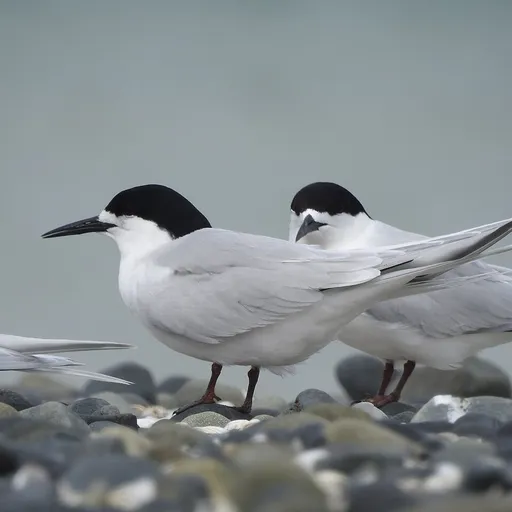
White-fronted Tern
Sterna striata
Near Threatened
Overview
The white-fronted tern (Sterna striata) is a medium-sized tern and the most abundant of its kind in New Zealand, known by various names such as tara, sea swallow, and kahawai bird. First described by Johann Friedrich Gmelin in 1789, this species is currently classified as Near Threatened on the IUCN Red List and holds an at-risk/in-decline status in New Zealand.
Identification
- Average-sized bird, 35–43 cm in length with a 79–82 cm wingspan, featuring an all-white body, underwing, and forked tail, with light silvery-grey upper wings.
- Breeding adults display a striking black cap extending from the forehead to the nape, separated from the black bill by a narrow white strip; non-breeding adults have the black cap reduced to the top of the forehead.
- Long, slender, ebony-like bill and stumpy, deep burgundy-black legs; eyes are inky black and round.
- Voice includes a high-pitched 'siet' call used frequently in flight, a dull 'crek' for courtship, and a continuous 'keark' when descending on intruders.
Habitat
Found throughout New Zealand's coastline and offshore islands, with small breeding populations on Flinders and Cape Barren Islands in Australia's Bass Strait. They inhabit coastal waters, harbours, bays, estuaries, cliffs, and occasionally stony river banks, but seldom venture far inland. Large flocks prefer areas with sand, shell, or shingle, and they have even established breeding sites on human-made structures like disused concrete supports.
Diet
Carnivorous, feeding mainly on smaller fish such as smelt, pilchards, and larval fish, often targeting shoals forced to the surface by larger predators like kahawai and kingfish. They forage by diving 3–10 m into the water with very shallow dives, often in flocks of hundreds or thousands alongside gannets, shearwaters, and gulls.
Did you know?
Despite being the most abundant tern in New Zealand, they are extremely difficult to monitor because they seldom return to the same breeding sites year after year. They also engage in a unique courtship display where a male carries a fish while flying over potential mates, dropping it if he accepts a female’s choice, or retaining it if he does not.
Sources
- Wikipedia · CC BY-SA 4.0
- Wikidata · CC0 1.0