
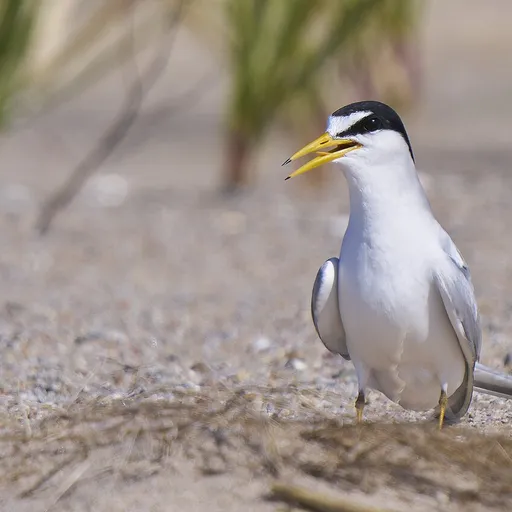
Least Tern
Sternula antillarum
Least Concern
Overview
The least tern (Sternula antillarum) is a small migratory tern that breeds in North America and locally in northern South America. It is closely related to the little tern of the Old World and is currently listed as a species of Least Concern on the IUCN Red List.
Identification
- Measures 22–24 cm in length with a 50 cm wingspan, featuring pale gray upperparts and white underparts.
- Possesses a black cap and eye-line to the bill base, a white forehead patch that becomes more extensive in winter, and yellowish legs.
- The bill is yellow with a small black tip in summer, turning all blackish in winter.
- Flies with fast, jerky wingbeats and a distinctive hunchback appearance with the bill pointing slightly downward.
Habitat
This species breeds in marine or estuarine shores, sandbar islands in large rivers, and areas free from humans or predators, ranging from the Atlantic and Pacific coasts of North America to the Caribbean and northern South America. It winters in Central America, the Caribbean, and northern South America, with vagrant records noted in Europe.
Diet
Least terns hunt primarily in shallow estuaries and lagoons, hovering until spotting prey and then plunging into the water without full submersion to extract meals. Common prey includes silversides smelt, anchovies, shiner perch, small crustaceans, and kelpfish, while insects are consumed during El Niño events.
Did you know?
In the southeastern United States, many breeding sites are established on white gravel rooftops, and in the San Francisco Bay region, nesting typically takes place on abandoned salt flats.
Sources
- Wikipedia · CC BY-SA 4.0
- Wikidata · CC0 1.0