
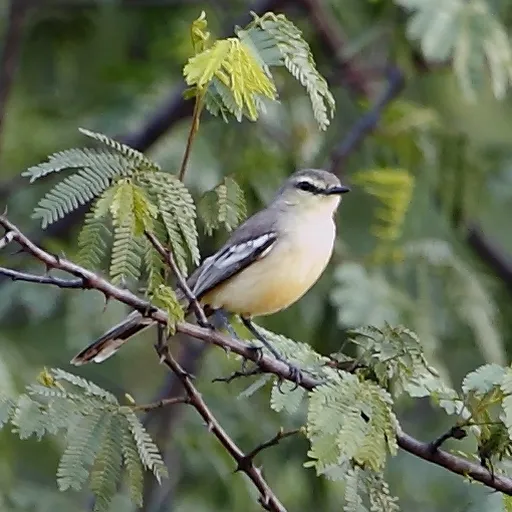
Greater Wagtail-Tyrant
Stigmatura budytoides
Least Concern
Overview
The greater wagtail-tyrant (Stigmatura budytoides) is a species of tyrant flycatcher found in parts of South America. It is currently classified as Least Concern by the IUCN and is considered fairly common to common across its disjunct range.
Identification
- Plumage: Adults of the nominate subspecies feature a bright yellow supercilium, a blackish eye-line, and dusky ear coverts on a yellowish face, with greyish olive upperparts and bright yellow underparts with a slight buffy tinge on the breast.
- Markings: Wings are dusky with wide white edges on the innermost flight feathers and coverts, forming a large white patch on the closed wing; the long tail has large white ovals at the tips of the outer feathers.
- Size: Measures 14 to 16 cm in length and weighs between 8.5 and 13.2 g.
- Song: Pairs often sing in duet, producing a 'high, liquid series of "Wee-tjer-"' and 'tidrrr-' or 'whididideteh' and 'tri-ti-treeowhit', accompanied by an abrupt 'churt'.
Habitat
The species inhabits the Gran Chaco biome, characterised by arid scrublands, dry deciduous woodlands, and gallery forest in savanna, while the Brazilian subspecies prefers somewhat moister landscapes. Its range spans parts of Argentina, Bolivia, Brazil, and Paraguay, typically occurring between sea level and 1,000 m, though reaching up to 2,700 m in Bolivia.
Diet
Feeding primarily on insects, the bird forages in pairs or family groups from near the ground to the tops of tall shrubs. It captures prey by gleaning from leaves, twigs, and bark while perched, using short sallies to hover-glean, and occasionally drops to the ground to feed.
Did you know?
Despite its name, the greater wagtail-tyrant does not actually wag its tail but instead cocks it up and sometimes pumps it, exposing the white tips of the outer tail feathers.
Sources
- Wikipedia · CC BY-SA 4.0
- Wikidata · CC0 1.0