
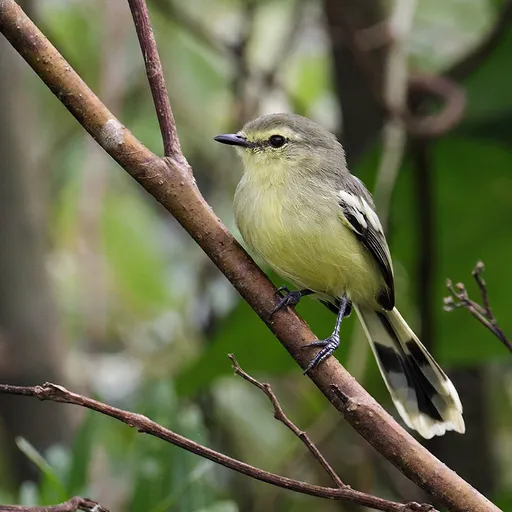
Lesser Wagtail-Tyrant
Stigmatura napensis
Least Concern
Listen
XC248764 · Niels Krabbe · Orellana: river island at Añangu, Ecuador · CC BY-SA 4.0
Overview
The lesser wagtail-tyrant is a species of tyrant flycatcher found in northern South America. It has a disjunct distribution, primarily along major river systems in the Amazon Basin, with a separate population in the upper Orinoco region.
Identification
- Size: 13 cm long with a long, dusky tail.
- Plumage: Grayish olive upperparts, medium yellow underparts, a thin pale yellow supercilium, and a blackish line through the eye.
- Wing Markings: Dusky wings feature a large white patch on the closed wing formed by wide edges on innermost flight feathers and coverts.
- Tail Pattern: Outer tail feathers have large white ovals at the tips and a yellowish-white band at the base.
- Voice: Amazon Basin populations sing an asynchronous duet consisting of a descending rattle and a mellow chow note, whereas Orinoco populations have a different rattle and melodic notes.
Habitat
The species primarily inhabits river islands and mainland river corridors, especially favoring early-successional areas thick with Tessaria, grass, and young trees such as Salix and Cecropia. It is found in the Amazon Basin of Brazil, Colombia, Ecuador, and Peru, and locally in the upper Orinoco Basin of Venezuela and Colombia. Its elevation range seldom exceeds 300 m, though it reaches 800 m in Colombia.
Diet
The diet is assumed to consist mostly or entirely of insects. It forages in pairs or family groups, actively moving through vegetation with short pauses, typically cocking its tail up to expose the white tips. Prey is captured by gleaning from leaves, twigs, and bark, and the bird sometimes drops to the ground to feed.
Did you know?
Despite being named a 'wagtail-tyrant', this species does not actually wag its tail, though it does cock it up and spread the feathers to expose the yellowish base and white tips.
Sources
- Wikipedia · CC BY-SA 4.0
- Wikidata · CC0 1.0