
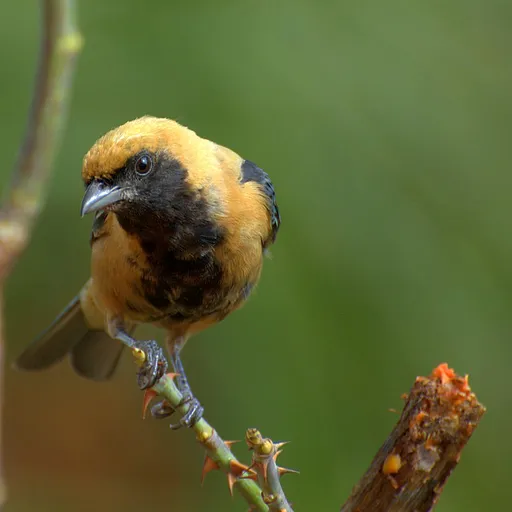
Burnished-buff Tanager
Stilpnia cayana
Overview
The burnished-buff tanager (Stilpnia cayana), also known as the rufous-crowned tanager, is a common South American bird in the family Thraupidae. It is widely distributed across northern South America and is notably adaptable to various semi-open environments.
Identification
- Males in the cayana group feature an orange-rufous crown, a black mask, and cream underparts tinged blue on the throat and chest.
- Males in the flava group have an orange-buff crown and buff underparts, with a black patch extending from the mask over the throat, central chest, and mid-belly.
- Males of both subspecies groups possess turquoise wings and tail.
- Females appear duller than males, with black restricted to a poorly demarcated 'shadow' of a mask.
Habitat
This species is found in the northern Guianas, most of Venezuela, east-central Colombia, near the Amazon River outlet in Brazil, and across most of eastern Brazil, Paraguay, and northeast Argentina. It also occurs very locally in Bolivia and Peru. It inhabits virtually any semi-open habitat with trees, including human-altered areas such as gardens, plantations, and parks.
Diet
Being largely frugivorous like all tanagers, it is particularly fond of the fruits of native Cecropia and Brazilian pepper, as well as introduced Magnoliaceae such as Michelia champaca. It is generally seen singly or in pairs.
Did you know?
The specific epithet of its original binomial name, Tanagra cayana, is the Latin form of the type locality, Cayenne in French Guiana. It was formally described in 1766 by the Swedish naturalist Carl Linnaeus in the 12th edition of his Systema Naturae.