
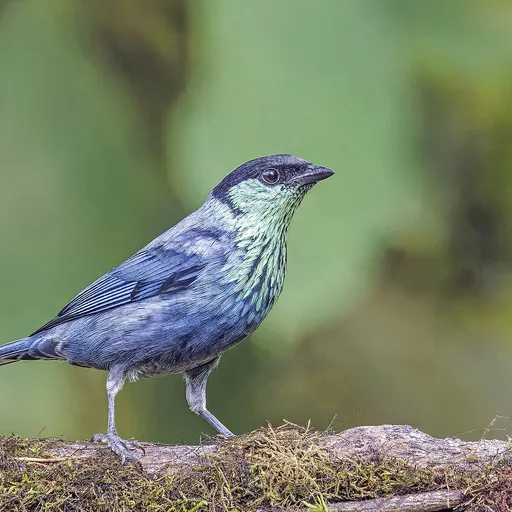
Black-capped Tanager
Stilpnia heinei
Listen
XC922967 · JUAN ANTONIO ALONSO DE JUAN · Vereda La Máquina, Pacho, Cundinamarca, Colombia · CC BY 4.0
Overview
The black-capped tanager is a Neotropical songbird in the family Thraupidae, native to the highlands of northern South America. It typically inhabits subtropical or tropical moist montane forests and degraded woodland areas, often occurring alone or in pairs.
Identification
- Males display a striking black crown that contrasts with shining silvery bluish-grey upperparts and an aquamarine-green or opalescent green throat and chest that appear streaked or scaly.
- Females are generally duller than males, featuring a uniform shining green upper body and a dusky crown with green edges that creates a slightly scaly look.
- Approximately 13 cm in length, it possesses a black beak and black legs, with dark brown irises.
- The bird sings a low-pitched, mechanical, ringing song that sounds like "t'kling-t'kling-t'kling", lasting up to ten seconds, and calls include a high-pitched "zheet" or "tsit".
Habitat
Found in the Andes of Colombia, Venezuela, Ecuador, and Peru, as well as the Sierra de Perijá and Santa Marta mountains, this species occupies elevations generally between 1,300 and 2,800 metres. It is found in tropical moist montane forests, forest edges, secondary woodland, and open landscapes with trees and bushes. An isolated record exists from 700 metres, and its presence on the western slopes of the Andes in Ecuador was only documented in 1980, suggesting a potential range expansion linked to deforestation.
Diet
This species forages for insects in low shrubs and trees, staying close to trunks and bare or moss-covered branches. It also consumes fruits such as whole berries and cecropia fruit. Unlike some other montane tanagers, it is more often seen foraging in clearings and outside the actual forest, frequently acting as a pair independent of mixed flocks.
Did you know?
To construct its cup-shaped nest, the female physically presses her body down into the structure while vibrating. The nest is meticulously held together using spider webs and egg sacs.