
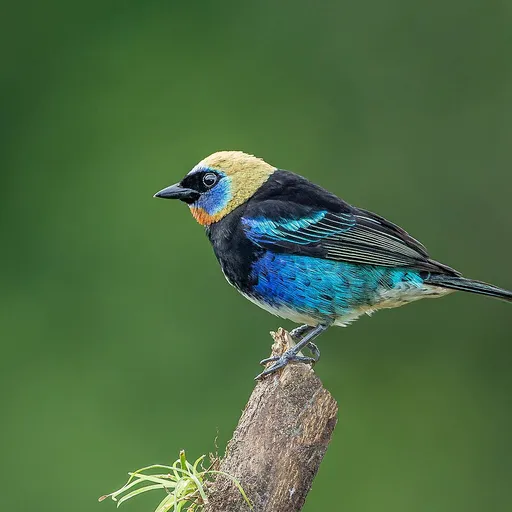
Golden-hooded Tanager
Stilpnia larvata
Overview
The golden-hooded tanager (Stilpnia larvata) is a medium-sized passerine bird that acts as a resident breeder from southern Mexico south to western Ecuador.
Identification
- Adult males feature a golden head with a black eyemask edged in violet blue, black upperparts with turquoise shoulders, rump, and wing edgings, blue flanks, and a white central belly.
- Females display a greenish head, often with black crown speckling, and more extensive white underparts than males.
- Immatures are duller with green heads, dark grey upperparts, off-white underparts, and minimal blue plumage.
- The call is a sharp tsit, while the song consists of a tuneless, rattled series of tick sounds.
Habitat
This species resides from sea level to 1,500 metres in the canopy of dense forests and semi-open areas such as clearings, second growth, and well-vegetated gardens.
Diet
Golden-hooded tanagers forage in pairs, family groups, or mixed-species flocks, consuming small fruits like Trophis racemosa which are usually swallowed whole, as well as insects.
Did you know?
This species is often double-brooded, with young birds from the first clutch assisting in feeding the second brood of chicks.