
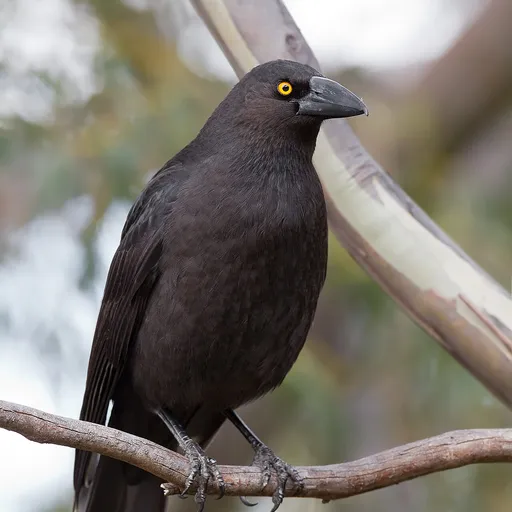
Black Currawong
Strepera fuliginosa
Least Concern
Overview
The black currawong (Strepera fuliginosa), also known as the black jay, is a large passerine bird endemic to Tasmania and the nearby islands within the Bass Strait. It is closely related to the butcherbirds and Australian magpie and is classified as Least Concern by the IUCN, although its King Island subspecies is vulnerable.
Identification
- A large, crow-like bird approximately 50 cm long with all-black plumage and distinct white patches on the wing tips and tail feathers.
- Features a heavy black bill, black legs, and bright yellow irises; sexes are similar in appearance, though males are somewhat larger and heavier.
- Produces a loud, varied call described as alternating 'kar' and 'wheek' sounds, or akin to part song and part human laughter, which is distinct from similar species.
- Immature birds possess brown-tinged plumage and a yellow gape, fading to black as they mature, with the black colour occasionally fading to dark brown with wear.
Habitat
The species is endemic to Tasmania, where it is widespread but rare below altitudes of 200 m, and is found on many islands in Bass Strait including the Hunter and Furneaux Groups. It inhabits wetter eucalypt forests, cool rainforest, alpine scrubland, and heathland, though it prefers denser forests and moist gullies in lowland areas. Generally sedentary, it may relocate to lower altitudes during winter or cross water bodies between islands and the mainland.
Diet
Omnivorous, its diet includes berries, invertebrates such as earthworms and insects, and small vertebrates including mice, lizards, and birds. It forages both on the ground and in tree canopies, using its bill to probe the earth or turn over clods and rocks, and has been observed breaking open ice on frozen lakes or foraging along beaches. It sometimes gathers in large flocks to raid orchards or feed in picnic areas, and is known to secure dead larger prey to logs to facilitate dismemberment.
Did you know?
Black currawongs have been observed digging wet yellow clay from drains and applying it to their plumage as a form of dirt bath, without washing it off afterwards. They also exhibit playful behaviour, including wrestling opponents onto their backs or juggling food items such as pears with their feet.
Sources
- Wikipedia · CC BY-SA 4.0
- Wikidata · CC0 1.0