
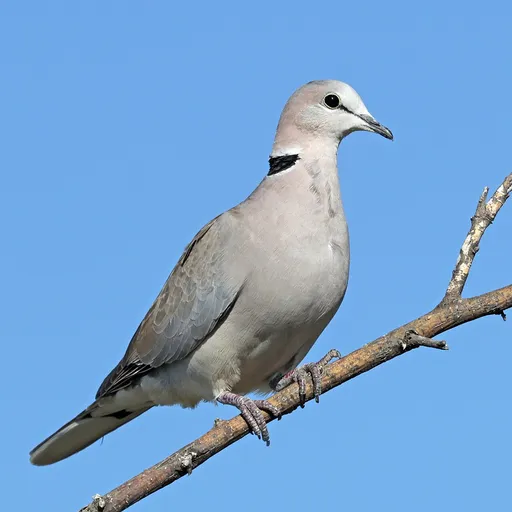
Ring-necked Dove
Streptopelia capicola
Least Concern
Overview
The ring-necked dove (Streptopelia capicola), also known as the Cape turtle dove, is a widespread and often abundant species found in East and southern Africa. It is a mostly sedentary bird that inhabits a variety of open habitats, from semi-desert scrub to woodlands and farmlands.
Identification
- Plumage: Dull grey-brown upperparts with lavender shades on the nape, and paler pinkish lavender underparts; features a semi-collar of black feathers on the lower nape in adults.
- Tail: Slate grey tail feathers with conspicuous white tips and fringes, a pattern that is particularly noticeable during display flight.
- Size: Measures 25–26.5 cm in length and weighs 92–188 g; males are slightly larger than females, though plumage is otherwise alike.
- Song: A loud, harsh, and rhythmic three-syllabled croon described as 'kuk-COORRRR-uk' or 'how's father?', repeated ten to forty times.
Habitat
Occupies a diverse range of habitats including semi-desert scrub, Boscia and Acacia savannah, various woodlands, farmlands, and open plantations. It avoids closed forests and extensive waterless dune fields or gravel plains, seldom occurring above 2,000 metres in altitude.
Diet
Feeds mainly on seeds from grasses, cereal grains, lupins, milkweeds, alien acacias, and pines, but also consumes broken fruit, berries, and occasional insects. They forage on the ground during the day, typically at dawn and dusk, and depend on surface water which they drink mainly in the morning.
Did you know?
The male performs a spectacular courtship display by flapping up a steep gradient before spiralling down with wings and tail spread out, often synchronised with a bowing motion and a rolling crooning call.
Sources
- Wikipedia · CC BY-SA 4.0
- Wikidata · CC0 1.0