
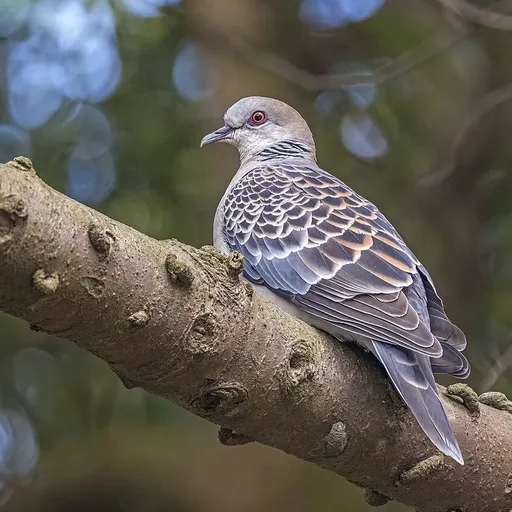
Oriental Turtle Dove
Streptopelia orientalis
Least Concern
Overview
The Oriental turtle dove (Streptopelia orientalis) is a member of the dove and pigeon family Columbidae with a wide native distribution across Asia. Populations in higher latitudes migrate south in winter, while those in tropical regions are sedentary, though vagrants have occasionally reached North America.
Identification
- The breast is less pink and the wing feathers are browner with darker centres than the European Turtle dove, creating a scaly appearance.
- It possesses a wedge-shaped tail and shares a black and white striped neck patch made of silver-tipped feathers.
- Unlike the European species, it lacks a bare patch of skin around the eyes.
- The call is a four-syllable 'her-her-oo-oo', differing from the purring of its European relative.
Habitat
Breeding occurs in well-wooded but open habitats, whereas wintering sites are generally more open but usually retain good tree cover. The range extends from Central Asia east to Japan, with northern populations migrating to winter in India, the Maldives, and southern Japan.
Diet
Predominantly granivorous, this species feeds on the seeds of hemp, sunflower, wheat, millet, and amaranth, as well as gastropods. Foraging takes place on the ground, where the birds are often observed burrowing with their feet in search of food.
Did you know?
The Ainu people traditionally interpret the bird's calls as elaborate sayings in their own language, ascribing specific meanings to the sounds.
Sources
- Wikipedia · CC BY-SA 4.0
- Wikidata · CC0 1.0