
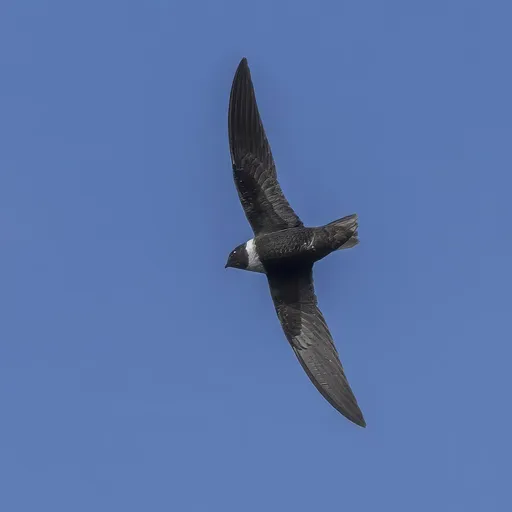
White-collared Swift
Streptoprocne zonaris
Least Concern
Listen
XC251568 · Niels Krabbe · Zamora-Chinchipe: Reserva Tapichalaca, near Q. Cristopher Parson, Ecuador · CC BY-SA 4.0
Overview
The white-collared swift (Streptoprocne zonaris) is the largest species of swift in its range, except in northwestern Mexico. It is classified as a species of least concern with an extremely large distribution across the Americas.
Identification
- 20 to 21.5 cm long with a wingspan of 45 to 55 cm and a very slightly forked tail.
- Adults feature a prominent white collar circling the neck, broadest on the breast, against a sooty black head and body.
- The back, rump, and uppertail coverts display a slight blue gloss.
- Vocalisations include a 'nasal twitter of chee chee chee, whiss whiss' and 'scratchy but not shrill tseet, tchee, and chirrio notes'.
Habitat
Found in Mexico, Central America, the Greater and Lesser Antilles, Trinidad, and every mainland South American country. It inhabits a wide variety of landscapes, most commonly over montane and submontane evergreen forests, but also lowland evergreen forests, secondary forests, and open scrublands. Its elevation range extends from the lowlands up to 3,600 m.
Diet
As an aerial insectivore, it feeds on flying insects, with specimens from southern Mexico found to have consumed almost exclusively flying ants. It often forages in large flocks of 200 or more, sometimes mixed with other swift species, using powerful and direct flight to ascend thermals.
Did you know?
These swifts can attain or exceed flying speeds of 70 to 100 km/h (43 to 62 mph). Their nesting sites are often dramatic, located within caves that contain a stream or behind a waterfall.
Sources
- Wikipedia · CC BY-SA 4.0
- Wikidata · CC0 1.0