
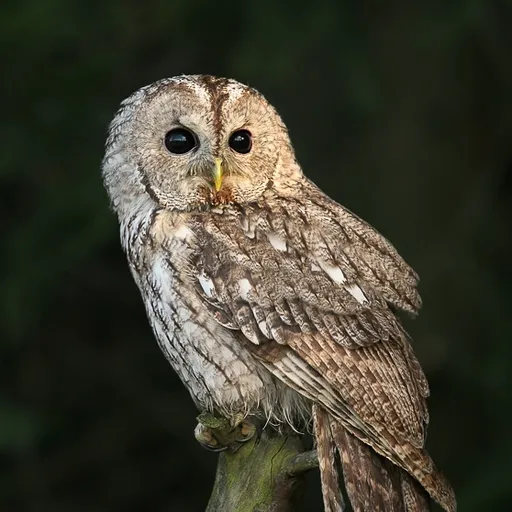
Tawny Owl
Strix aluco
Least Concern
Listen
XC707099 · Sonothèque ADVL · Jullouville, Manche, Normandie, France · CC0 1.0
Overview
The tawny owl (Strix aluco), also known as the brown owl, is a stocky, medium-sized nocturnal bird of prey in the family Strigidae. It is a non-migratory species with a wide distribution across temperate Europe and western Siberia, where it maintains highly defended territories.
Identification
- Robust build, 37–46 cm in length, with a large rounded head that lacks ear tufts and a plain facial disc surrounding dark brown eyes.
- Plumage varies by morph: upperparts are either rufous brown or greyish, while underparts are whitish and streaked with brown.
- Flight is silent, heavy, and slow with long glides on rounded wings; top speed reaches approximately 50 mph.
- The male's call is a quavering song (hoo...ho, ho, hoo-hoo-hoo-hoo), whereas the female makes a shrill contact call (kew-wick).
Habitat
Found in deciduous and mixed forests, mature conifer plantations, and urban areas with wooded patches, preferably near water. Its range stretches across temperate Europe and western Siberia, though it is notably absent from Ireland and only a rare vagrant to the Balearic and Canary Islands.
Diet
Hunts primarily at night from perches, taking prey such as rodents, small mammals, birds, earthworms, and beetles, often swallowing items whole and regurgitating indigestible parts as pellets. In urbanised areas, its diet includes a higher proportion of birds, sometimes including species like mallards and kittiwakes.
Did you know?
Despite having retinal light sensitivity comparable to humans, the tawny owl relies on asymmetrically placed ears to pinpoint prey, a skill so effective that it can hunt in total darkness but may starve during prolonged wet weather if raindrops mask the faint sounds of its victims.
Sources
- Wikipedia · CC BY-SA 4.0
- Wikidata · CC0 1.0