
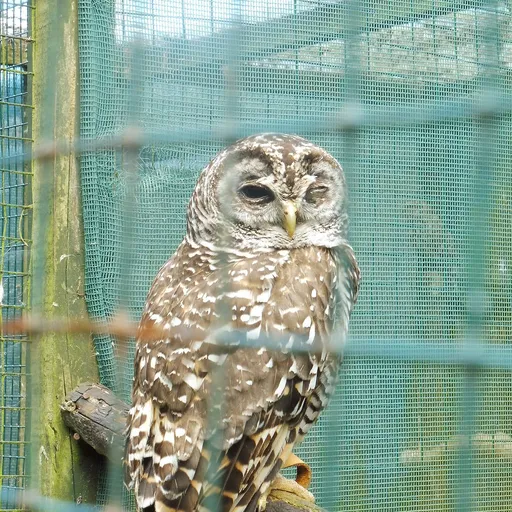
Chaco Owl
Strix chacoensis
Near Threatened
Overview
The Chaco owl (Strix chacoensis) is a monotypic owl species native to southern South America, specifically Argentina, Bolivia, and Paraguay. It was originally described as a species before being briefly reclassified as a subspecies of the rufous-legged owl, but was later restored to full species status based on morphological and vocal evidence.
Identification
- Measures 35 to 38 cm in length, with males weighing 360–435 g and females 420–500 g.
- Features a round head with no ear tufts and a pale grayish white facial disk marked with concentric dark lines.
- Upperparts are dusky brownish black with narrow white and yellowish buff barring; underparts are off-white with dark brown barring.
- The male's song is described as a frog-like 'crococro craorr-craorr craorr-craorr', while the female's call is similar but higher pitched.
Habitat
The species inhabits the Gran Chaco biome in hilly, rolling, and flat terrain with a variety of forest types, ranging from dense to semi-open. Its range extends from Bolivia's Santa Cruz Department south through western Paraguay into north-central Argentina, reaching as far as Córdoba and Buenos Aires provinces. In Argentina, it is found at elevations between 500 and 1,300 m.
Diet
Primarily nocturnal, the Chaco owl hunts from a perch by dropping on or flying to small mammals, birds, reptiles, and invertebrates. It is also vocally active at dawn and dusk.
Did you know?
Captive females have been observed to lay two to three eggs, though the breeding phenology of wild birds remains poorly known.
Sources
- Wikipedia · CC BY-SA 4.0
- Wikidata · CC0 1.0