
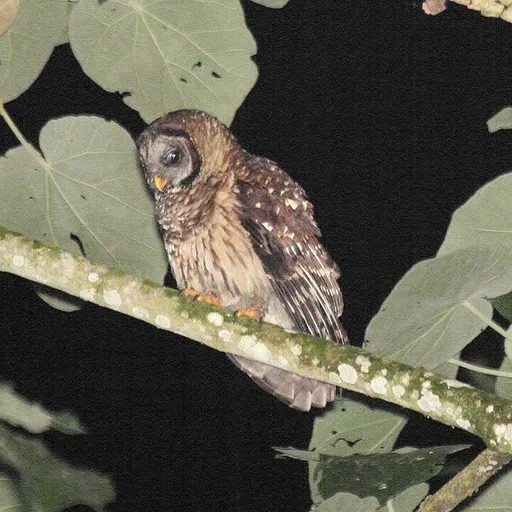
Fulvous Owl
Strix fulvescens
Least Concern
Listen
XC485523 · Oliver Komar · Opatoro, Departamento de La Paz, Honduras · CC BY-SA 4.0
Overview
The fulvous owl (Strix fulvescens), also known as the Guatemala barred owl, is a medium-sized true owl native to the cloud forests of Central America. It is a resident of highland regions in Guatemala, Honduras, and El Salvador, and is currently classified as a species of least concern by the IUCN.
Identification
- Plumage: Warm dark brown or reddish brown on the back with lighter brown underparts featuring darker barring; the facial disc is dull brownish-white with concentric dark brown bars and short white eyebrows.
- Size: Approximately 41–44 cm in length, weighing around 600 grams, with females typically heavier than males.
- Structure: Possesses a round head lacking ear tufts, a yellowish bill, and legs feathered in reddish-brown down to the yellowish toes.
- Vocalisation: Emits a loud, barking hoot described as "who-wuhu-woot-woot", a call whose rhythm has been likened to Morse code.
Habitat
This montane species inhabits elevations between 1,200 and 3,100 meters, primarily within montane evergreen pine forests, humid pine-oak forests, and broader cloud forest habitats. Its range covers highland areas of Guatemala, Honduras, El Salvador, and parts of Mexico, although its distribution remains poorly known.
Diet
The diet of the fulvous owl is not well understood but is believed to consist of rodents, large insects, birds, frogs, and lizards. The species hunts from a perch, as evidenced by observations of individuals attempting to catch highland guan and the presence of blue-throated motmot feathers near nests.
Did you know?
In parts of Mexico, the fulvous owl was traditionally considered a messenger of death. It is visually similar to the barred owl but is distinguishable by its warmer brown coloration compared to the greyer upperparts of the barred owl.
Sources
- Wikipedia · CC BY-SA 4.0
- Wikidata · CC0 1.0