
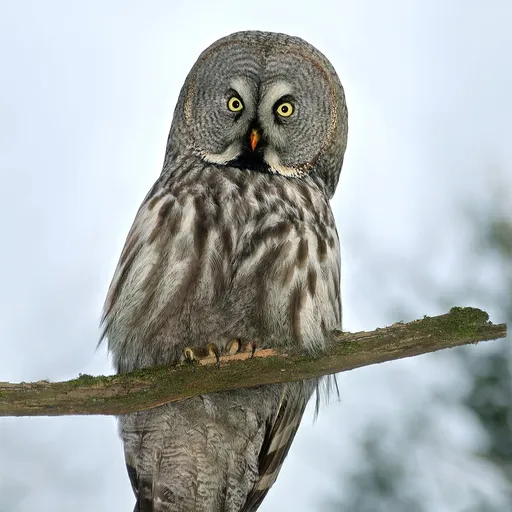
Great Grey Owl
Strix nebulosa
Least Concern
Listen
XC985998 · Robert Petersen · Lindesberg Municipality, Örebro County, Sweden · CC BY-SA 4.0
Overview
The Strix nebulosa is a true owl and the largest species by length, distributed across the Northern Hemisphere. It is the only species in the genus Strix found in both Eastern and Western Hemispheres.
Identification
- Large, rounded head with the largest facial disc of any raptor, featuring a white 'bow-tie' collar just below the beak.
- Grey upperparts with pale bars and light underparts with dark streaks, lacking ear tufts.
- Yellow eyes surrounded by darker circles.
- A call consisting of very deep, rhythmic 'who's, though adults are normally silent at other times.
Habitat
In northern areas, breeding habitat consists of dense coniferous forests of the taiga near open areas such as meadows or bogs, while in Oregon and California, nesting occurs in mixed oak woodlands. It is distributed across North America from central Alaska to Quebec and southern states like California, as well as Northern Eurasia from Fennoscandia through Siberia to northeastern China.
Diet
These birds wait, listen, and watch for prey before swooping down, relying on excellent hearing to locate small mammals even beneath snow. They rely almost fully upon small rodents such as lemmings, pocket gophers, and voles, with alternative prey including squirrels, hares, and small birds comprising less than 20% of their intake.
Did you know?
This species can 'snow-plunge' to capture prey moving beneath 60 cm of snow, a habit thought to require superb hearing not possessed by all types of owls.
Sources
- Wikipedia · CC BY-SA 4.0
- Wikidata · CC0 1.0