
Himalayan Owl
Strix nivicolum
Least Concern
Overview
The Himalayan owl or Himalayan wood owl is a medium-sized owl native to the forests and mountain ranges of the Himalayas, Taiwan, and Korea. Although populations are declining, the species is currently listed as Least Concern on the IUCN Red List due to its large range and slow decline.
Identification
- Measures 35–40 cm in length with a wingspan of approximately 270 mm.
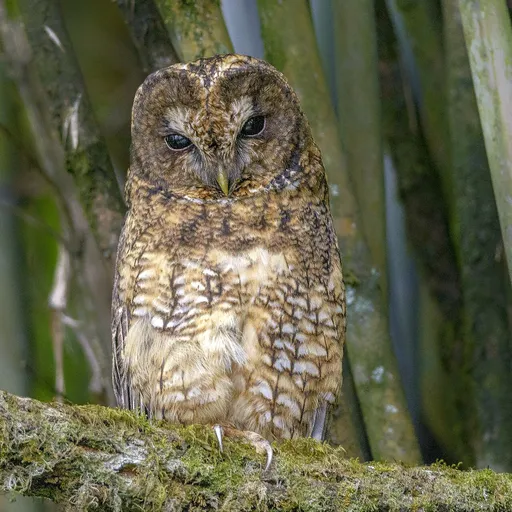
- Possesses warm-toned, tawny plumage with a light brown and white chest featuring vertical dark brown stripes.
- Has a round, dark brown head without ear tufts and a small, hooked, yellow beak.
- Song consists of two fast, dove-like hoots described as "coo-coo", while its call is a high-pitched, slow "whoo".
Habitat
The species inhabits a widespread territory throughout East Asia and the Himalayas, consistently residing in coniferous and oak forests as well as rocky ravines. Although its distribution is stationary year-round, the owl has been observed descending to lower elevations during the winter months.
Diet
As a nocturnal generalist, the Himalayan owl hunts at dusk by perching in trees and using its powerful hearing to locate prey. It feeds on insects, small birds, and small mammals, with rodents such as shrews and mice being its primary food source.
Did you know?
After eggs are laid, both the male and female exhibit a slower descent and spread their wings more widely when entering the nest, a behavioural change thought to prevent damage to the eggs.
Sources
- Wikipedia · CC BY-SA 4.0
- Wikidata · CC0 1.0