
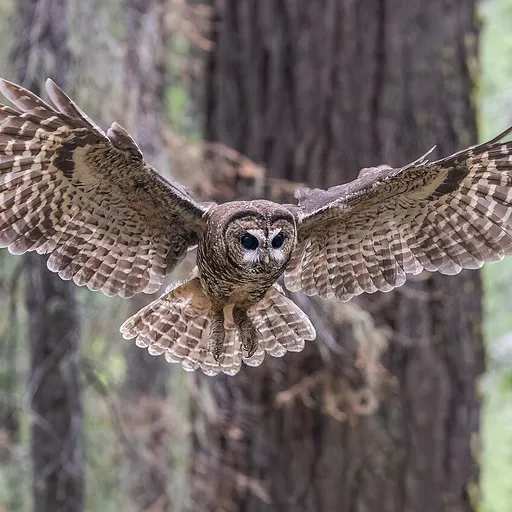
Spotted Owl
Strix occidentalis
Near Threatened
Overview
The spotted owl (Strix occidentalis) is a species of true owl and a resident of old-growth forests in western North America. Classified as near-threatened on the IUCN Red List, the species faces significant pressure from habitat destruction and competition with barred owls.
Identification
- Average length of 43 cm with a wingspan of 114 cm and a weight of 600 g.
- Distinguished from the larger, grayer barred owl by its cross-shaped markings on the underparts.
- Adults are brownish with white spots, though the text notes they are smaller and darker than their barred owl counterparts.
Habitat
The species inhabits hardwood and coniferous forests, strongly preferring closed-canopy, uneven-aged, and late-successional old-growth environments. Its range extends from British Columbia through the western United States to Mexico, with elevations varying from 70 to 8,500 feet depending on the subspecies.
Diet
As a nocturnal sit-and-wait predator, the spotted owl hunts from perches, swooping or pouncing on prey. Its diet primarily consists of small mammals such as northern flying squirrels and woodrats, though it also consumes smaller birds, amphibians, reptiles, and insects.
Did you know?
Spotted owls are under threat from barred owls, which are more aggressive and have a broader diet; where these two genetically distinct species interact, they may hybridise to produce an interspecific hybrid known as a "sparred owl".
Sources
- Wikipedia · CC BY-SA 4.0
- Wikidata · CC0 1.0