
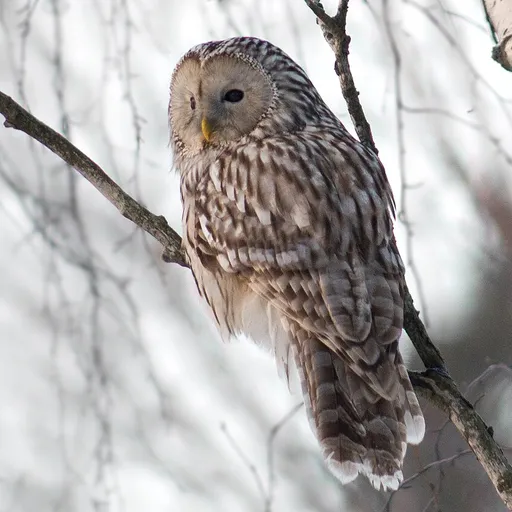
Ural Owl
Strix uralensis
Least Concern
Listen
XC314568 · Alexander Kürthy · Trešková, Mokrá Lúka, Revúca District, Banská Bystrica Region, Slovakia · CC BY-SA 4.0
Overview
The Ural owl (Strix uralensis) is a large, nocturnal forest owl belonging to the family Strigidae. Although its name references the Ural Mountains of Russia where the type specimen was collected, it possesses an extremely broad distribution across the Palearctic. It is currently classified as a species of Least Concern by the IUCN.
Identification
- Plumage: Usually a pale greyish-brown to whitish colour with a darker back and mantle contrasting against whitish markings; underparts are pale cream-ochre with heavy dark brown streaking but no crossbars.
- Size and Build: A very large owl, ranging from 50 to 64 cm in length with an exceptionally long, wedge-tipped tail that is often slung downwards in flight.
- Head and Features: Broad, rounded head with a facial disc lacking concentric lines; dark brown, almond-shaped eyes that appear relatively small and closely set.
- Flight: Characterised by deeper, more relaxed wing beats that resemble a buzzard's flight, with buffish-white underwings marked by heavy dark bars.
Habitat
The Ural owl is primarily associated with the vast taiga forests of Eurosiberia, though it also occupies mixed and temperate deciduous forests. Its range extends west to Scandinavia and central Europe, across Russia to Sakhalin, and throughout Japan. It is a stable species that has been aided by reintroductions in parts of central Europe despite some local decreases.
Diet
This species is a dietary generalist but is usually reliant on small mammals, particularly rodents such as voles. Ural owls tend to vigorously protect set territories and nest in tree cavities, stumps, or artificial nest boxes. Breeding success is strongly correlated with the availability of prey populations.
Did you know?
The Ural owl possesses ears that are amongst the largest recorded in owls, averaging 24 mm on the left and 27 mm on the right, which, combined with a well-developed facial disc, highlights the critical role of sound in its hunting strategy. Despite this vocal capability, the species is generally very quiet for a large owl and may go nearly two days without vocalising even during peak times.
Sources
- Wikipedia · CC BY-SA 4.0
- Wikidata · CC0 1.0