
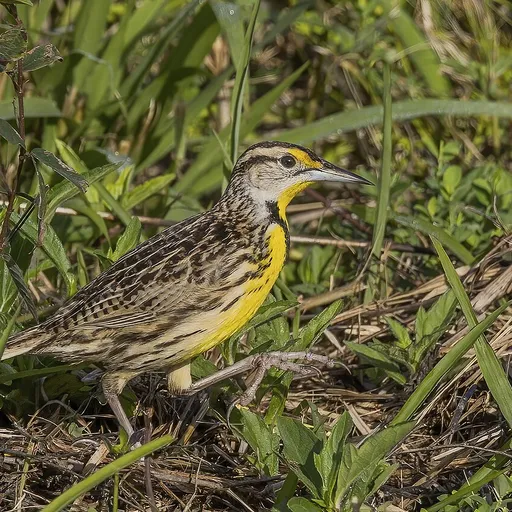
Eastern Meadowlark
Sturnella magna
Near Threatened
Listen
XC320443 · Jonathon Jongsma · Afton State Park, Washington County, Minnesota, United States · CC BY-SA 4.0
Overview
The eastern meadowlark (Sturnella magna) is a medium-sized icterid bird that occurs from eastern North America to northern South America. Classified as Near Threatened by the IUCN Red List, the species is distinct from its sister species, the western meadowlark.
Identification
- Size: Adults measure 19–28 cm in length with a wingspan of 35–40 cm.
- Plumage: Features yellow underparts with a black 'V' on the breast, white flanks with black streaks, and brown upperparts with black streaks; non-breeding plumage shows more yellow-brown flanks and distinct head striping.
- Bill: Possesses a long, pointed bill.
- Song: Characterised by pure, melancholy whistles, which are simpler than the jumbled, flutey song of the western meadowlark.
Habitat
Breeding habitat consists of grasslands, prairie, pastures, and hay fields, though the species is also found in agricultural-type areas where tall grasses are allowed to grow. It is a permanent resident throughout much of its range, although most northern birds migrate southwards in winter.
Diet
These birds forage on the ground or in low vegetation, sometimes probing with their bills, and often feed in flocks during winter. Approximately three-quarters of their diet consists of animal sources such as beetles, grasshoppers, and crickets, supplemented by seeds and berries.
Did you know?
Although the range of the eastern meadowlark overlaps with that of the closely related western meadowlark, incidents of hybridisation are thought to be rare, as both species avoid sharing territories and only interbreed when mates are scarce.
Sources
- Wikipedia · CC BY-SA 4.0
- Wikidata · CC0 1.0