
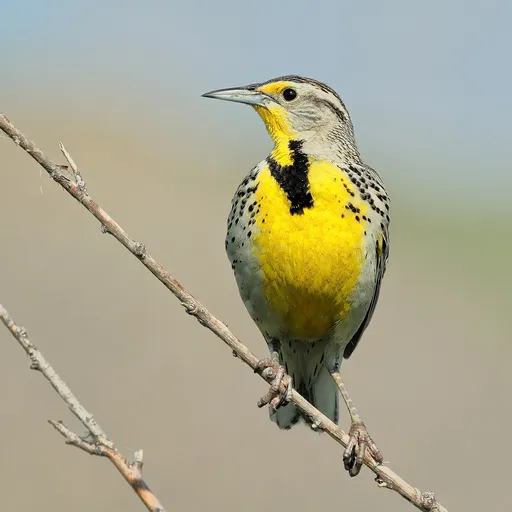
Western Meadowlark
Sturnella neglecta
Least Concern
Listen
XC550994 · Peter Wilton · Santa Teresa County Park (near San Jose), Santa Clara County, California, United States · CC BY-SA 4.0
Overview
The western meadowlark (Sturnella neglecta) is a medium-sized icterid bird measuring approximately 20 cm in length. It is found across western and central North America and is classified as Least Concern on the IUCN Red List.
Identification
- Yellow underparts with a distinctive black 'V' on the breast and white flanks streaked with black.
- Upper parts are mostly brown with black streaks, and the head is striped with light brown and black bands.
- Features long, pointed bills and a wingspan of 41 cm.
- Possesses a distinctive, flute-like warbled song that contrasts with the simple, whistled call of the eastern meadowlark.
Habitat
This species inhabits grasslands, prairies, pastures, abandoned fields, and shrublands across western and central North America, extending as far south as northern Mexico. Breeding occurs in western Canada and the western United States west of the Great Lakes, with northern populations migrating south for the winter while southern populations remain resident. The species has also been successfully introduced to the island of Kauai in Hawaii.
Diet
Western meadowlarks forage on the ground or in low to semi-low vegetation, sometimes probing with their bills. They primarily consume insects, though they also eat seeds and berries. During winter, these birds often feed in flocks.
Did you know?
Despite having 'lark' in their name due to their melodic song, western meadowlarks are not true larks but are members of the New World blackbird family. The species serves as the state bird for six US states, a record second only to the northern cardinal.
Sources
- Wikipedia · CC BY-SA 4.0
- Wikidata · CC0 1.0