
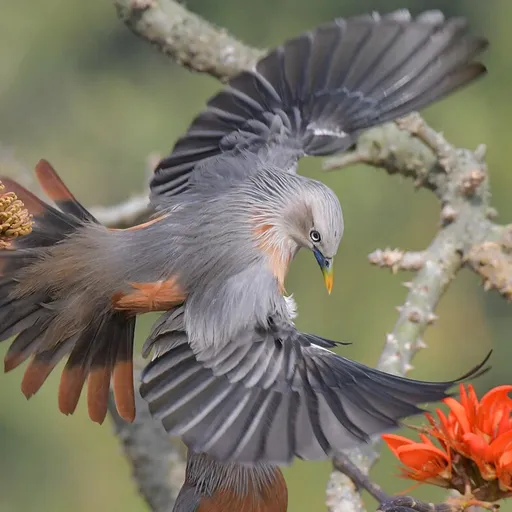
Chestnut-tailed Starling
Sturnia malabarica
Least Concern
Overview
The chestnut-tailed starling (Sturnia malabarica) is a small passerine bird found in wooded habitats across India and Southeast Asia. It is classified as a species of Least Concern on the IUCN Red List.
Identification
- Approximately 20 cm in length with grey upperparts and blackish remiges.
- Light grey head featuring whitish streaking, particularly on the crown and collar.
- White irises and a yellow bill with a pale blue base.
- Underparts vary by subspecies: rufous in the nominate subspecies, and whitish tinged rufous in S. m. nemoricola.
- Juveniles possess whitish underparts and chestnut tips on the tail feathers.
Habitat
This species inhabits wooded habitats in India and Southeast Asia, with its range covering India (excluding the southwest and northeast), south Nepal, Bangladesh, south Assam, Myanmar, and north and central Indochina. It acts as a resident or partially migratory species, visiting peninsular India during the winter months.
Diet
The chestnut-tailed starling is fairly omnivorous, consuming a diet of fruit, nectar, and insects. It forages by flying in tight flocks that frequently and rapidly change directions with great synchrony.
Did you know?
While the chestnut-tailed starling builds its nest in old barbet or woodpecker holes in tree trunks 3–12 m high, it performs poorly understood movements that have resulted in records from Pakistan and central and southern India outside its primary range.
Sources
- Wikipedia · CC BY-SA 4.0
- Wikidata · CC0 1.0