
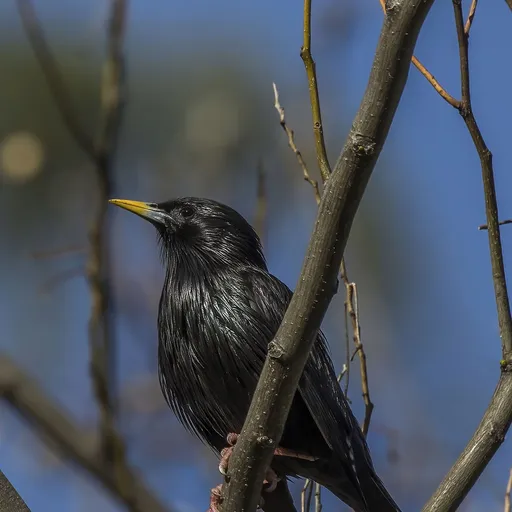
Spotless Starling
Sturnus unicolor
Least Concern
Listen
XC431986 · Joost van Bruggen · El Condado (near Almonte), Huelva, Andalucía, Spain · CC BY-SA 4.0
Overview
The spotless starling (Sturnus unicolor) is a passerine bird in the family Sturnidae that is closely related to the common starling but possesses a much more restricted range. It is largely non-migratory and currently categorised as Least Concern on the IUCN Red List.
Identification
- Marginally larger than the common starling, measuring 21–23 cm in length and weighing 70–100 g.
- Features darker, oily-looking black plumage with purple or green glosses that is entirely spotless in spring and summer, with only very small pale spots appearing in winter.
- Displays conspicuously long throat feathers that form a shaggy 'beard', which is particularly obvious when the bird is singing.
- Has bright pink legs and a yellow bill with a bluish base in males or a pinkish base in females during summer, turning duller and blackish in winter.
Habitat
The species is confined to the Iberian Peninsula, Northwest Africa, southernmost France, and the islands of Sicily, Corsica and Sardinia. It occupies a wide range of reasonably open environments, from farmland and olive groves to human habitation, with the highest population densities found in open grazed holm oak woods and urban areas.
Diet
An omnivore, it consumes a wide variety of invertebrates, berries, and human-provided scraps. It is gregarious and forms sizeable flocks, often mixed with common starlings, which can reach up to 100,000 individuals in winter.
Did you know?
It can form flocks of up to 100,000 individuals in winter, often mixed with common starlings. Its calls are similar to those of the common starling but are noticeably louder.
Sources
- Wikipedia · CC BY-SA 4.0
- Wikidata · CC0 1.0