
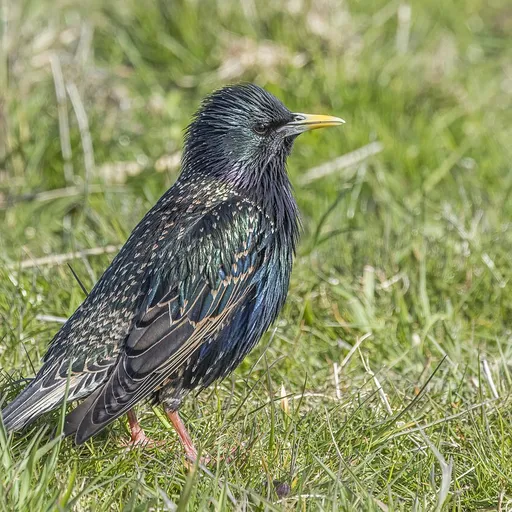
Common Starling
Sturnus vulgaris
Least Concern
Listen
XC1034387 · Philippe_Grange · Arrondissement de la Roche-sur-Yon (near La Roche-sur-Yon), Vendée, Pays de la Loire, France · CC0 1.0
Overview
The common starling, also known simply as the starling in Great Britain and Ireland, is a medium-sized passerine bird in the starling family. It is classified as Least Concern by the International Union for Conservation of Nature due to its huge global population.
Identification
- Medium-sized passerine about 19–23 cm long with an iridescent black plumage glossed purple or green, spangled with white, especially in winter.
- Sharp, blade-like bill that is brownish-black in winter and yellow with blue-grey bases in summer for males.
- Stout, rufous-coloured legs and a relatively short tail, giving it a round-bellied shape.
- Flight is strong and direct with rapidly beating triangular wings, while on the ground it exhibits a strange, waddling gait.
Habitat
The species breeds in open habitats across temperate Europe and across the Palearctic to western Mongolia, with some populations migrating to Iberia and North Africa in winter. It has also been introduced as an invasive species to Australia, New Zealand, Canada, the United States, Mexico, Argentina, South Africa, and Fiji. Very large roosts, up to 1.5 million birds, form in city centres, woodlands, and reedbeds.
Diet
This bird is largely insectivorous, consuming a wide range of arthropods such as spiders, beetles, and ants, as well as earthworms, snails, small amphibians, and lizards. It is omnivorous and also eats grains, seeds, fruits, nectar, and food waste. Starlings use a specialised feeding technique involving inserting their bill into the ground and opening it to search for hidden food items.
Did you know?
Common starlings are renowned for their gift of mimicry, capable of replicating songs of other bird species and various man-made noises, a trait noted in literature by Pliny the Elder and William Shakespeare. In some instances, a wild starling has been observed to mimic a sound it has heard only once.
Sources
- Wikipedia · CC BY-SA 4.0
- Wikidata · CC0 1.0