
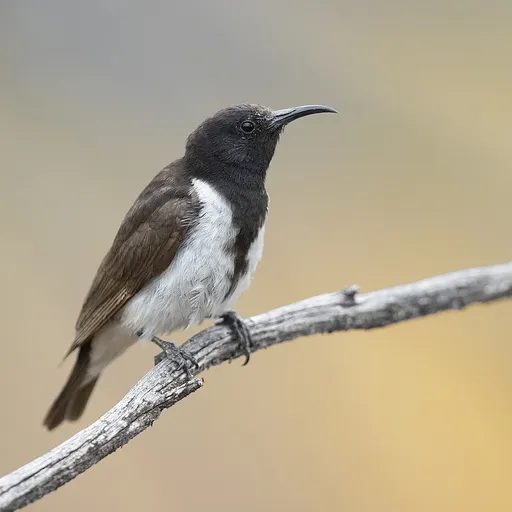
Black Honeyeater
Sugomel nigrum
Least Concern
Overview
The black honeyeater (Sugomel nigrum) is a small bird in the family Meliphagidae, endemic to the arid inland regions of Australia. As the sole surviving species in its genus, it is a habitat specialist dependent on the presence of emu bush and related flowering shrubs.
Identification
- Adult males are black and white, whereas females are speckled grey-brown with a pale eyebrow; immatures resemble adult females.
- Very small, measuring between 10 and 13 cm in length, with a long, slender, down-curved bill.
- Flight is described as remarkably quick with zigzag starts; the bird often hovers around flowers when feeding.
- Calls include a soft metallic 'chwit' and a monotonous 'tieee' during the breeding season.
Habitat
Found in open woodlands, shrublands, mallee, and spinifex savannas across arid and semi-arid Australia, particularly where emu bush occurs. The species is migratory, with movements tied to the flowering of food plants, ranging from western Queensland and New South Wales to Western Australia and the Northern Territory.
Diet
Primarily a nectar feeder, it hovers at tubular flowers such as those of the emu bush to probe with its long bill, and also hawks small insects in mid-air. Breeding females regularly consume ash from campfires, likely to obtain calcium for egg production and to repair deficits after laying.
Did you know?
The bird is also known as the charcoal bird because breeding females are frequently observed eating ash from campfires, an activity described as resembling bees buzzing around a honeypot.
Sources
- Wikipedia · CC BY-SA 4.0
- Wikidata · CC0 1.0