
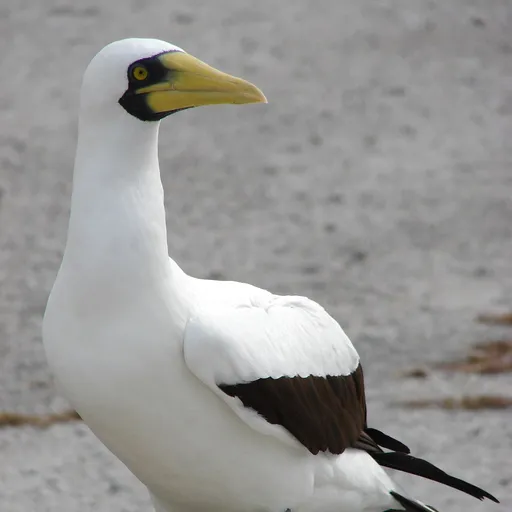
Masked Booby
Sula dactylatra
Least Concern
Overview
The masked booby (Sula dactylatra), also known as the masked gannet or blue-faced booby, is a large seabird belonging to the family Sulidae. It is the largest species of booby and is classified as Least Concern on the IUCN Red List.
Identification
- The adult is bright white with dark brown-black wings and tail, featuring a conical bill longer than the head that is yellow with a slight greenish tinge and a backward-pointing serrated edge.
- A distinctive blue-black or dark mask covers the bare skin of the face, throat, and lores, contrasting sharply with the white plumage.
- It is a large bird measuring 75–85 cm in length with a wingspan of 160–170 cm; the legs are yellow-orange or olive, and the iris is yellow.
- Males produce a descending whistle while females emit a loud honk, though the species is generally silent at sea.
Habitat
The species ranges across tropical oceans between the 30th parallel north and 30th parallel south, absent from the eastern Atlantic and eastern Pacific where it is replaced by the Nazca booby. Nesting takes place in colonies on remote islands, atolls, and cays located above the high-tide level, requiring nearby deep water for foraging.
Diet
The masked booby primarily feeds on flying fish and squid, capturing prey through high-speed plunge diving into the ocean.
Did you know?
The species name dactylatra is derived from the Greek for 'finger' and Latin for 'black', referring to the splayed wingtips seen in flight.
Sources
- Wikipedia · CC BY-SA 4.0
- Wikidata · CC0 1.0