
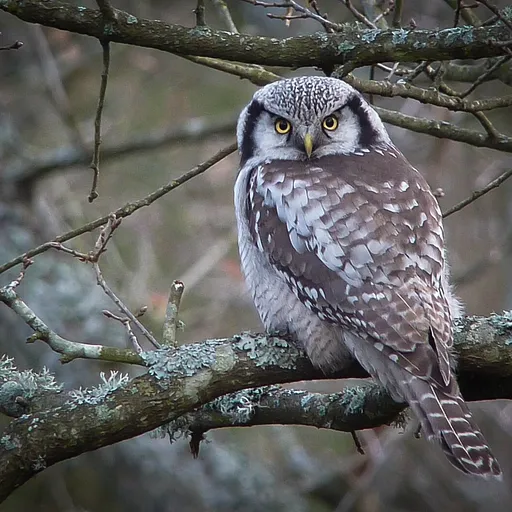
Northern Hawk-Owl
Surnia ulula
Least Concern
Listen
XC1063279 · Juan Carlos Albero · Utsjoki (near Gárnjárga), Pohjois-Lappi, Lappi, Finland · CC0 1.0
Overview
The northern hawk-owl (Surnia ulula) is a medium-sized true owl of the northern latitudes that is unique among its kind for being active during the day. As the only living species in its genus, it is a non-migratory bird that typically remains within its breeding range, though it may occasionally irrupt southward following prey abundance. It is classified as a species of Least Concern by the IUCN Red List.
Identification
- Relatively dark brown plumage with off-white spotting on the dorsal parts, contrasting with a white or off-white underbelly featuring brown bands.
- A white face bordered in black, a rounded head, bright yellow eyes, and a curved yellow beak.
- Distinctive calls include a rolled whistle sounding like ulululululululul to attract mates, and a high-pitched scream followed by a yip when the nest is threatened.
Habitat
Found across the northern Holarctic, the species primarily inhabits open coniferous forests or mixed forests with deciduous species such as larch, birch, poplar, and willow. It also occupies muskegs, clearings, swamp valleys, meadows, and recently burnt areas, while generally avoiding dense spruce-fir forests. Its range spans from eastern Alaska through Canada to Newfoundland, and across northeastern Europe and Siberia.
Diet
The northern hawk-owl feeds on a variety of prey, including small rodents, larger mammals, and numerous bird species, with voles making up the majority of its biomass in Eurasia and snowshoe hares being crucial in North America. As a partially diurnal hunter, it perches in open areas, often on spruce trees, and scours the immediate area for prey. When attacking, it glides from a horizontal posture into a dive, sometimes flapping its wings to increase distance, and can plunge into snow to capture rodents below the surface.
Did you know?
This species exhibits a fierce defence of its young, attacking humans and even large animals such as moose if they approach too closely to the nest or fledglings. It has exceptional hearing that allows it to detect and capture rodents hidden beneath the snow.
Sources
- Wikipedia · CC BY-SA 4.0
- Wikidata · CC0 1.0