
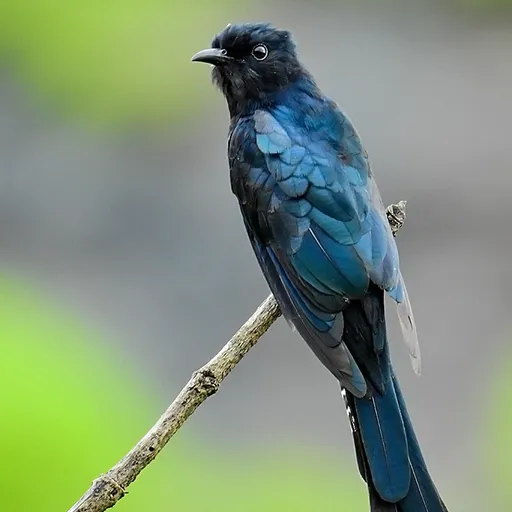
Fork-tailed Drongo-Cuckoo
Surniculus dicruroides
Least Concern
Overview
The fork-tailed drongo-cuckoo, or Surniculus dicruroides, is a species of cuckoo that closely resembles the Black drongo in appearance. It is a brood parasite that mimics its host species to lay its eggs in their nests, ensuring the host parents raise its young. The species is currently classified as Least Concern on the IUCN Red List.
Identification
- Glossy blue to purple or greenish black plumage with a white patch at the base of the feathers and a white barred vent.
- A forked tail with slight narrow white bars and a white spot on the back of the head.
- A down-curved black bill with an orange mouth lining, and black or blueish-grey tarsi and toes.
- Song consists of a series of 5 or 6 whistling "pip" notes rising in pitch, accompanied by "quip" calls in flight.
Habitat
Found mainly in hill forests, scrub jungle, plantations, and orchards across peninsular India and Sri Lanka, though it also inhabits woodland and sometimes plains. Altitudes range from the lower Himalayas at approximately 200m up to 2,600m. The bird is an arboreal species that keeps to the canopy foliage but moves to exposed bare branches when calling, particularly during the breeding season.
Diet
This insectivore feeds primarily on insects, especially caterpillars and soft-bodied insects caught in flight or snapped from trees. It occasionally supplements its diet with fruits such as banyan and figs.
Did you know?
The species is a brood parasite that mimics the appearance of the Black drongo, a strategy that aids in parasitism just as hawk-cuckoos mimic hawks. Hatchlings instinctively push out the host's eggs and nestlings to ensure they are the only ones cared for by the host parents.
Sources
- Wikipedia · CC BY-SA 4.0
- Wikidata · CC0 1.0